Agrivoltaics: Making Marginal Land More Productive With Solar Panels and Sheep
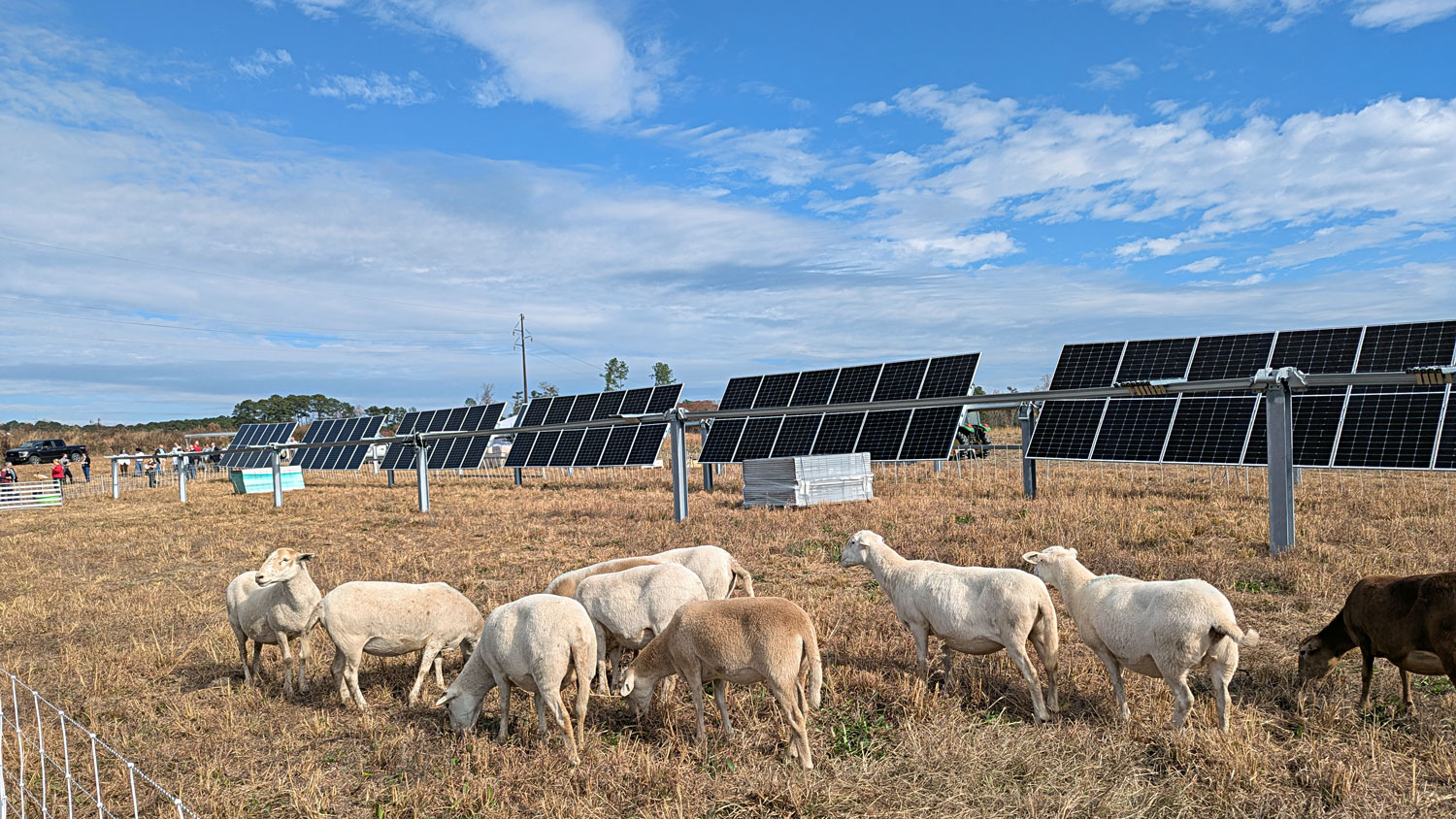
The bumpy ride to a new demonstration site at NC State University, where sheep grazed next to solar panels, showed the potential of marginal land such as this rugged terrain five miles from campus.
Located on the edge of NC State’s 1,800-acre Lake Wheeler Road Field Lab, the demonstration site is the first in the Southeast with an all-terrain solar panel system from partner Nevados that can adapt to the landscape, including uneven ground.
While unsuited for conventional crops, land like this can be used for raising sheep to meet a growing U.S. demand for lamb and for generating renewable energy to supply an increased need for electricity, said Todd See, head of NC State’s Department of Animal Science.
“This will be an integral part of our programs in animal science and how we can bring animal agriculture into what’s going on in the agrivoltaics space,” See said. “So we’re very excited about that opportunity.”
Project partners are Nevados solar, NC State’s College of Engineering and College of Agriculture and Life Sciences and the North Carolina Clean Energy Technology Center.

Thousands of North Carolinians visit Lake Wheeler Road Field Lab each year for hands-on education and training. The new demonstration site will bring in solar employees from Nevados, agricultural producers, and animal science and engineering students, said Megan Jacob, senior associate dean of administration for NC State’s College of Agriculture and Life Sciences (CALS).
“At CALS, we like to talk about future-proofing, and a project like this, where we’re preparing agriculture, energy systems, and students and communities to thrive under changing times and circumstances, is a beautiful connection to what we try to do every day,” Jacob said.
“This project not only future-proofs the land through diversification, it future-proofs our students by teaching them new skills and new technologies. And it allows our systems to integrate renewable energy and power with agricultural productivity.”
The agrivoltaics project will bring innovation and workforce development to the Food Animal Initiative, an interdisciplinary collaboration of CALS and NC State’s College of Veterinary Medicine (CVM) to establish North Carolina as a leader in food animal biosciences, Jacob said.
Within the next two years, NC State plans to relocate its Small Ruminant Unit in northwest Raleigh to Lake Wheeler, expanding the opportunities for students to work with sheep and goats while remaining close to campus.
Don’t Sleep on Sheep
In the afternoon sun, the Katahdin ewes conserved energy, resting in the shade of the solar panels, which also provide some wind protection.
That’s one of many reasons that sheep are a great fit with solar sites, said Andrew Weaver, an Extension small ruminant specialist at NC State. Their grazing significantly reduces the need for mowing to keep the area around the panels open.
“To me, they’re the most scalable vegetation management system,” Weaver said.
Because they’re “vertically challenged,” sheep don’t climb on the panels and they’re too lightweight to cause damage, which is a concern with cattle, he added.
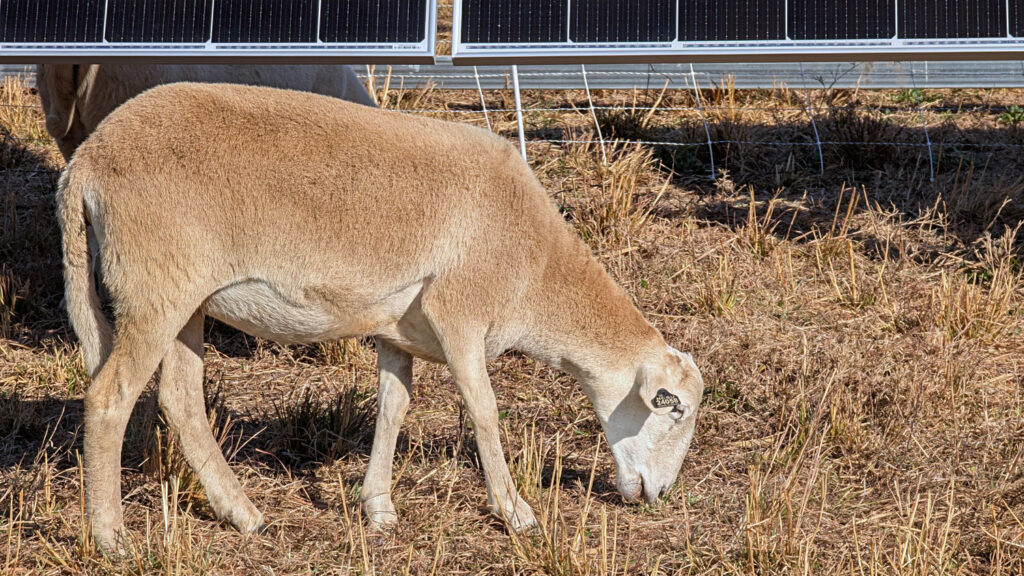
Katahdin sheep grow hair rather than a heavy fleece, making them more heat-tolerant in the Southeast and eliminating the need for shearing. Raised for meat rather than wool, Katahdin sheep can provide farmers with new options.
North Carolina is already seeing a rise in sheep numbers to meet the growing consumer demand for lamb, which has increased for four consecutive years, according to the U.S. Department of Agriculture. More than 70% of lamb that Americans consume is imported, with the largest share coming from Australia, followed by New Zealand.
“There’s a huge opportunity to raise more American lamb,” Weaver said. “I think solar sites can provide some economies of scale.”
While grazing can be paired with solar panels in many locations, it adds value on marginal land and rugged terrain, Weaver said.
Practical Advice
After the ribbon-cutting, Weaver gave a training on the ins and outs of raising sheep on a solar site.
Solar companies need to work with farmers to establish palatable grasses that will nourish the sheep, preferably before any panels are installed, he said. To preserve topsoil health, it’s vital to have a grazing plan that makes use of movable paddocks with electrified fences. Water access is paramount, so having a well nearby is recommended, rather than hauling water.
Weaver advises having both full-time guard dogs to protect the sheep from predators and herding dogs that come on site to move sheep from one paddock to another.
For now, NC State has set aside 60 acres surrounding the agrivoltaics site that can be divided into 5-acre paddocks, ultimately accommodating several hundred sheep, See said.
“We needed uneven terrain to show off this technology. We thought what a great place to do it and what a great opportunity,” he said.