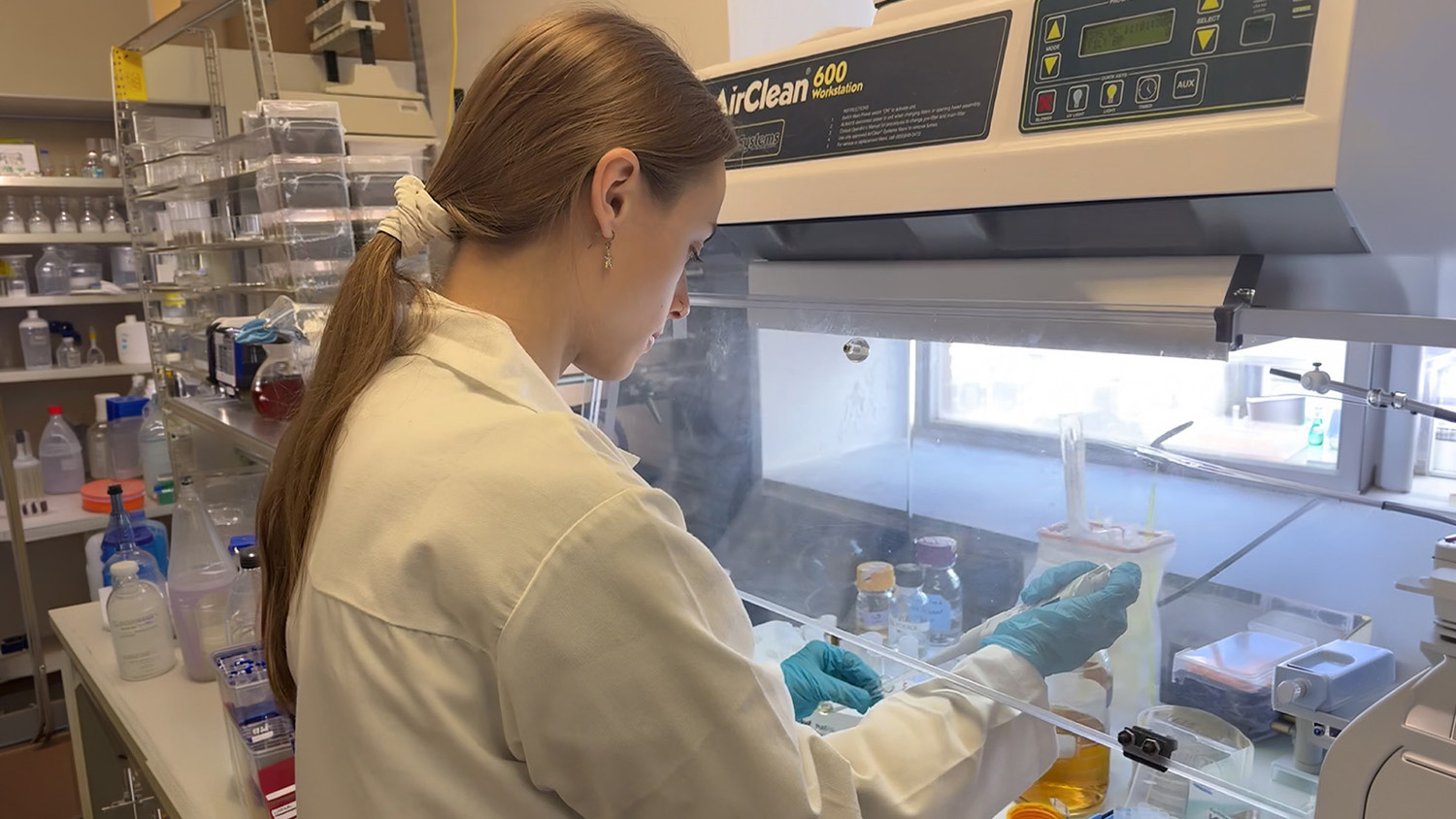
Building a Better NEST Program for the Nation’s Egg Industry
A $3.5 million USDA Research Facilities Act award will help NC State establish a first-of-its-kind, fully integrated poultry layer and egg processing research, training and innovation facility.

What does it take to get an egg safely from the hen house to your refrigerator?
More science and technology than you might think.
Consumer demand for cage-free farming systems has led to investments in new technologies, sometimes well before the technologies are ready for mass adoption. Modern egg processing plants can wash, inspect, grade and package thousands of eggs every hour. Keeping those systems running safely and efficiently requires cutting-edge research, skilled workers and well-trained inspectors.
Soon, they’ll have a new place to learn and innovate.
NC State University has received a $3.5 million award from the U.S. Department of Agriculture’s National Institute of Food and Agriculture through the Research Facilities Act Program to help establish the National Egg Science and Technology (NEST) Program. The federal award matches $3.5 million already committed by industry partners, the Golden LEAF Foundation and NC State creating a $7 million investment in research and training infrastructure for the U.S. egg industry.
“There is tremendous value in bringing researchers, students, industry and government together around the same table and, in this case, the same equipment,” said Garey Fox, dean of NC State’s College of Agriculture and Life Sciences. “The NEST Program is exactly the kind of partnership a land-grant university should lead. We’re building capacity that will serve North Carolina while helping solve challenges for an industry that feeds people across the country.”
Filling a National Gap
The NEST program began with egg producers and industry partners who identified a critical gap in research, technology testing and workforce training and brought that need to NC State.
As their land-grant partner, NC State stepped up to help address it. Industry partners backed that vision with more than $1 million in early commitments, helping get the project off the ground.
The NEST program will provide something the United States does not currently have: a dedicated farm-to-fork program where researchers, federal regulators and industry professionals can work together to advance egg production and processing, food safety and workforce training.
Today, federal inspectors often train in commercial egg processing plants, requiring companies to accommodate training within active production facilities. Researchers and companies face similar challenges when they want to test new technologies and processing methods under real-world conditions.
NEST will provide a dedicated place to do that work across the entire journey of an egg, from the farm to the consumer’s plate.
The program will connect two research facilities designed to work together. At the N.C. Department of Agriculture and Consumer Services’ Piedmont Research Station near Salisbury, a 4,000-square-foot research aviary will allow scientists to study commercial-scale egg production, including cage-free housing systems, animal health and welfare, genetics, productivity and egg quality.
On NC State’s main Raleigh campus, a 17,000-square-foot facility on Hillsborough Street will become a dedicated egg processing center with laboratories, a processing floor and training spaces for shell egg research, USDA inspector and industry workforce training, and continuing education.
NEST’s location on a major research campus is intentional. It will allow poultry scientists to work alongside experts in engineering, food safety, veterinary medicine and other disciplines to tackle challenges that don’t fit neatly within a single field.
At the center of the processing facility will be a Sanovo GraderPro 110, a state-of-the-art system capable of grading and processing up to 39,600 eggs per hour. Provided by Sanovo Technology Group, the $1 million system uses advanced automation and AI-assisted grading technology similar to equipment used by major egg processors.
Together, the two facilities will create an integrated research environment spanning egg production, grading, processing and packaging. Researchers will be able to study questions ranging from animal health and productivity to egg quality, nutrition, food safety and new value-added products, and follow those questions through multiple stages of production.
It also means researchers can test emerging technologies at a meaningful scale, inspectors can train on modern equipment, and students and industry professionals can gain hands-on experience with the systems they will encounter in the field.
By connecting the farm and processing sides of the industry, NEST will give researchers and partners something they have not had before: the ability to study and improve the egg production system as a whole.
Built for North Carolina, With National Reach
North Carolina offers a natural home for the NEST program.
Agriculture and associated industries generated $117 billion in economic activity in the state in 2024 and supported approximately 1 million jobs, making the sector North Carolina’s largest employer.
NC State is also home to the Prestage Department of Poultry Science, one of only six poultry science departments in the country. The department produces approximately one-third of the nation’s poultry science graduates and has longstanding relationships with poultry producers, regulators and allied industries.
Those relationships are already shaping the NEST program. In addition to Sanovo Technology Group’s support, major U.S. egg producers have committed more than $1 million toward renovations, and NC State has pledged more than $1 million to the NEST program. The Golden LEAF Foundation has also invested $500,000 in the program’s 4,000-square-foot research aviary at the NCDA&CS Piedmont Research Station near Salisbury.
With the federal match now in place, the project is expected to move quickly toward completion.
The result will be more than a new laboratory. The NEST program will give researchers, regulators and industry a place to work side by side on the technologies, training and food safety challenges shaping the future of the egg industry.
And that gives a whole new meaning to building a better nest.
- Categories: