Curiosity Guides 2026 Keller Award Winners

By Jimmy Ryals
Long before they became researchers in animal and plant genetics, Junjian Wang and Anna Yaschenko were curious kids. Decades later, the winners of the 2026 Kenneth R. Keller Research Award through the College of Agriculture and Life Sciences at NC State University are still following that curiosity and advancing scholarship in their fields.
As a child in Jinhua, China, Wang developed a fascination with the pigs raised by local farmers. Known as the “panda pig” for its black and white coloring, the Jinhua hog is globally renowned for producing quality meat.
“That inspired my interest in animal genetics and animal science,” Wang says. “I wanted to understand the genetics behind it and help breed better pigs. ”
Eight thousand miles away in Gaithersburg, Maryland, Yaschenko’s love for genetics and bioinformatics took root during the annual take-your-child-to-work days with her dad, who worked at the National Institutes of Health.
“I really enjoyed all the workshops they had, and that’s how I first learned about genetics,” she says.
Today, those childhood inspirations have led to research careers that meaningfully push the boundaries of knowledge in animal and plant science. Named for the late, longtime CALS professor William Keller, the Keller Award is a $2,500 prize awarded annually for excellence in doctoral dissertation research.
Building Better Tools for Animal Genetics
After finishing his bachelor’s and master’s studies at China Agricultural University in 2021, Wang was looking for a doctoral program that would let him marry his love of animal science with his interest in statistics. He found that in Jicai Jiang’s animal science lab at NC State.
Jiang, an assistant professor, is a respected expert in statistical genomics, and his lab offered an unusual level of flexibility in searching for the genetic foundations of the qualities livestock breeders prize.
“Many quantitative genetic labs in animal science focus on applying existing tools for analysis,” Wang says. “However, many of these tools were originally developed for human genetics and may not translate well to livestock populations. In Dr. Jiang’s lab, we develop our own methods to tackle new computational challenges and better fit the unique characteristics of animal data.”

Wang’s research focuses on three key aspects of livestock genomics:
- Investigating the practical utility of deep learning approaches relative to conventional statistical methods for genomic prediction in livestock
- Building a framework to identify which functional regions of the genome play an outsized role in shaping complex trait variation in livestock, helping bridge genetic signals to biological meaning
- Developing new fine-mapping methods tailored to livestock populations to more precisely pinpoint the specific genetic variants responsible for complex traits, overcoming limitations of tools originally designed for human genetics
That last area is where Wang’s work truly advanced existing scholarship. Traditionally, fine mapping in livestock has depended on methods and tools created for the study of humans. When applied to animals, however, those approaches produce high rates of false positives, Wang explains. Human datasets have less statistical noise because the underlying population is more genetically diverse. Most livestock populations are the product of targeted breeding, and they’re full of animals that are related to one another.
Wang developed models that adjust for the differences between humans and livestock, Jiang wrote in a letter recommending Wang for the Keller award, solving “fundamental methodological challenges that have been a long-standing limitation in animal breeding research.”
Moreover, Jiang wrote, Wang used open-source software in his work so that others in the field could apply his work to their own challenges.
After Wang graduated with a Ph.D. in animal science in 2025, he stayed at NC State for a year of postdoctoral study. This summer, he’ll start a postdoc program in human genetics at the University of Pennsylvania.
“I want to become a bridge between animal genetics and human genetics,” Wang says. “There is so much the two fields can share, and I hope to contribute a unique perspective to both.”
Authentic Innovation in Synthetic Biology
Alongside Yaschenko’s youthful interest in genetics, she developed a love for computer programming. Those topics shaped her undergraduate career at the University of Maryland, Baltimore County, where she earned dual degrees in computer science and bioinformatics and computational biology.
Anna Stepanova and José Alonso’s lab within the Department of Plant and Microbial Biology at NC State proved to be the perfect place for her to continue pursuing her education while exploring a different field altogether: plant synthetic biology. In five and a half years as a Ph.D. student under Stepanova and Alonso, Yaschenko contributed to six journal manuscripts, with another paper currently in preparation, serving as author or co-first author on four of them.
“Those were awesome opportunities,” she says. “It took a lot of hard work, but if you really want to contribute, you have to take those opportunities.”
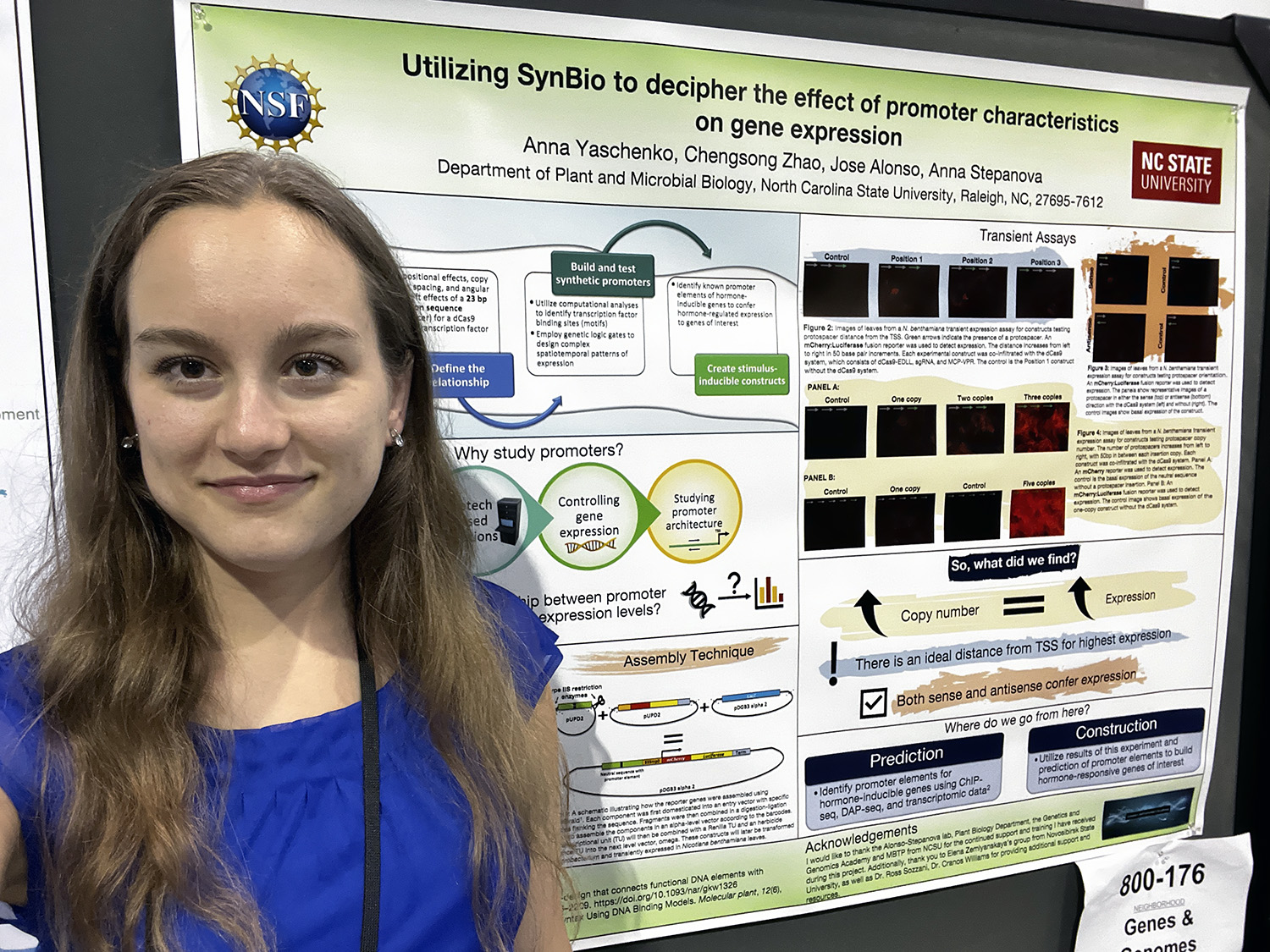
Synthetic promoters — DNA sequences engineered to control gene expression in conjunction with other important factors — were the focus of Yaschenko’s most significant research. Her dissertation explores promoter grammar: the rules defining how spacing, orientation and other elements of promoter design relate to levels and patterns of gene expression, particularly in plants. Predictably controlling genetic expression is one of the core problems in plant synthetic biology.
Her work “advances the field from empirical trial and error toward rational design principles that can guide reliable engineering in real plant systems,” Ross Sozzani, a professor of systems and synthetic biology, wrote in a Keller recommendation for Yaschenko.
In addition to her research, Yaschenko took an active role in managing the lab, helping delegate lab cleaning and other tasks. That experience, along with her aptitude for understanding complex research papers, led to her current role as a business development specialist and project manager for Black Canyon Consulting. Yaschenko began working for the firm, which supports federal research and development contracts, as a part-time project manager while working on her Ph.D in plant biology. She graduated in December of 2025 and was able to secure a full-time role in their business development sector.
“As a scientist working on your Ph.D., you’re reading so many different papers and having to figure out how to digest them, especially in fields that are slightly different from the one that you’re a niche expert in,” she says. “I think those skills transfer really well to trying to understand contracting language.”