WNCStrong: Shaping Youth Service After Hurricane Helene
By Amy Burtch
Receiving news of Hurricane Helene’s destruction to her hometown was not easy for Angel Cruz, who was living in Raleigh when the devastating storm hit western North Carolina last September.
Her Yancey County family and extended family were impacted.
“In the midst of disaster, I was particularly struck by the kids out of school and thought about their emotional experience,” says Cruz, academic and Extension manager for the Center for Environmental Farming Systems (CEFS) at NC State University.
“Many of the youth lost their homes or helped with search and rescue. They witnessed their parents in trauma, and being out of school, they sometimes had nothing to do,” she says.
It was in these contemplative moments that Cruz began dreaming of how to serve two needs at one time: rebuilding agriculture in affected communities and engaging impacted youth.
That dream became the WNCStrong Youth Service Corps.
A Desire to Serve
Cruz, who earned master’s and doctoral degrees at NC State, coordinates and manages educational programming at CEFS; therefore, her role in the creation of the WNCStrong Youth Service Corps is not surprising. And being from the region, the endeavor was personal.
She was introduced to Eric Klein, who had spent two decades connecting western North Carolina school systems and universities through college access programs, was also raised in Yancey County and living in Buncombe County when the hurricane hit.
Together, the two wrote and secured a grant to “help rebuild resilient food and agricultural systems” in western North Carolina communities affected by the hurricane, engaging youth from the communities in the work.


“I am not good at shoveling muck, but I am good at crafting youth programming,” Klein explains. “Working on this grant was an opportunity to create a support program that I was passionate about.”
A grant from the U.S. Department of Agriculture’s National Institute of Food and Agriculture (NIFA) and a generous contribution from the North Carolina Alliance for Health (NCAH) enabled Cruz and Klein to establish partnerships with school districts in Buncombe, Mitchell and Yancey counties.
They received funding to conduct a one-year pilot program, with NCAH providing the youth stipends. The pilot runs through this November, but Cruz and Klein are working on grants from private foundations to continue this important work.
“What we are doing with these youth and their agricultural communities is rare and powerful,” Klein says.
Creating the Corps
The WNCStrong Youth Service Corps engages one high school in both Yancey and Mitchell counties and two in Buncombe County, with a total of 22 students placed on nine farms across these three localities.
The farms include family and community farms, three of which are giving gardens. Cruz and Klein worked with community partners, like the Appalachian Sustainable Agriculture Project and Tractor Food and Farms, to identify farms in need that could accommodate teenagers.
“We leaned on the teachers to help with processes, like student recruitment,” Klein says. “They knew the kids best and understood which students would truly benefit from this work.”


Teacher mentors are paid an honorarium, and each youth works at a farm for 10 hours per week, helping with recovery, rebuilding and replanting, and, in turn, supporting the economic resilience of their host sites.
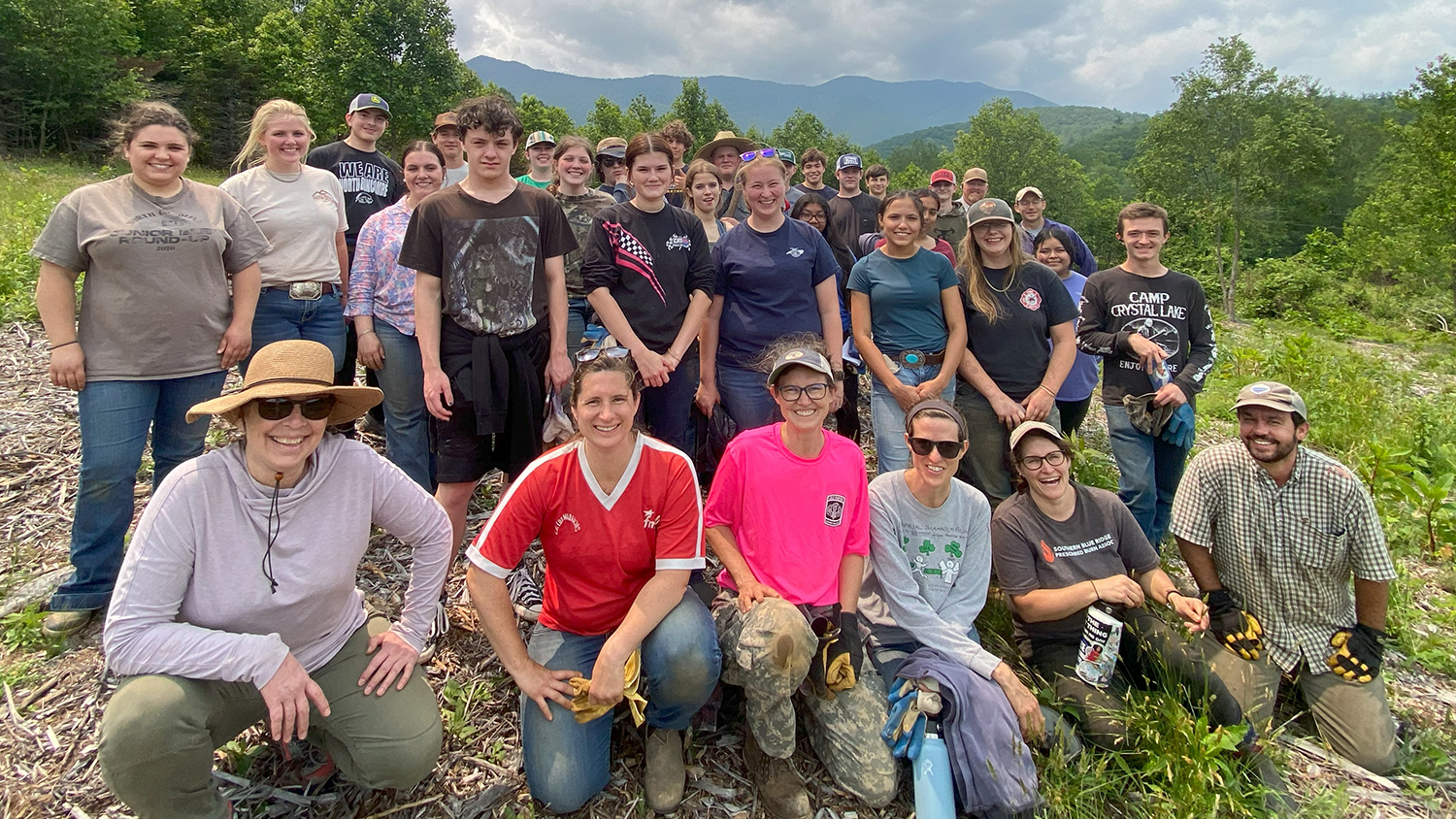
“We come together for monthly group workdays, at which 32 participants can unite for an even bigger clean-up,” Cruz shares. “Each youth will also complete a personal project, driven by student interest and support of the community.”
The program will conclude with a closing ceremony in November, which will include presentations of personal projects and a celebration.
Corps in Action
On the first group workday earlier this year, the youth helped clear the woods around a small Yancey County farm and build a riparian barrier around a new, storm-created creek running wildly through the farm. They put in native plants to stabilize the stream bank so the creek would not threaten the rest of the farm.
“That was a visually stunning piece to see these kids working together to mitigate a remnant of this disaster,” Klein says.
Beyond supporting disaster recovery and rebuilding agricultural systems, another main goal of the program is fostering the “socio-emotional resilience of impacted youth,” Cruz explains. She has seen this happen firsthand.
Cruz relays a story of one young lady whose English and professional skills have improved during her rebuilding of a children’s garden, and another young man who had not spent much time outside or in group activities, now building a fence on his own.
“I’ve seen firsthand the pride he has taken in learning how to build and use tools as well as in making something with his own hands,” she says.
Klein reflects on a student at the Leicester Library Giving Garden, who is developing a small food pantry, similar to the Little Free Library concept, for his personal project.
“This student independently called Weaverville’s town manager to inquire about appropriate locations for his food pantry, demonstrating that his Corps’ experience has improved his self-confidence and encouraged him to take initiative,” Klein says.

Student Growth
Kaylee Buchanan of Mountain Heritage High School signed up for the Corps because she wanted to help people.
“I knew it would not be the easiest job ever, but I knew it had a good reason, and I wanted to learn more about agriculture while helping small businesses,” Buchanan says.
She works at Davis Farms in Burnsville, where the experience has shifted her understanding of food systems in western North Carolina.
“Doing this makes you think more about your food and where it comes from,” Buchanan says. “It makes you appreciate food more because farming is hard work, and maintaining crops requires dedication.”
Chayan Capellupo, who also worked on Davis Farms, says participating in the Corps has impacted her future career path: “It sparked this interest within me. I really want to do hands-on work outside rather than just looking at a screen.”
Beauty in Community
It’s evident Cruz and Klein care deeply about these communities, their students and their agricultural systems, and both have found the experience deeply rewarding.
Klein refers to this project as “creative work” as he and Cruz created something that did not exist before.
“There was a blank canvas, and we are now ‘painting’ across three counties in a way that benefits students and their communities,” he says.
And Cruz is committed to building future leaders in agriculture. Even if these youth do not pursue agriculture as a career, she’s confident they have a stronger understanding of where food comes from and what it takes to grow it.
“It’s been powerful and beautiful to serve in an area I am from,” she says. “This project inspired me to move back and support my home community.”
- Categories:


