Fishing for Resilience
New research co-authored by applied ecologist Nadya Mamoozadeh explores the genetics and adaptability of brook trout to changing weather patterns.
By Jimmy Ryals
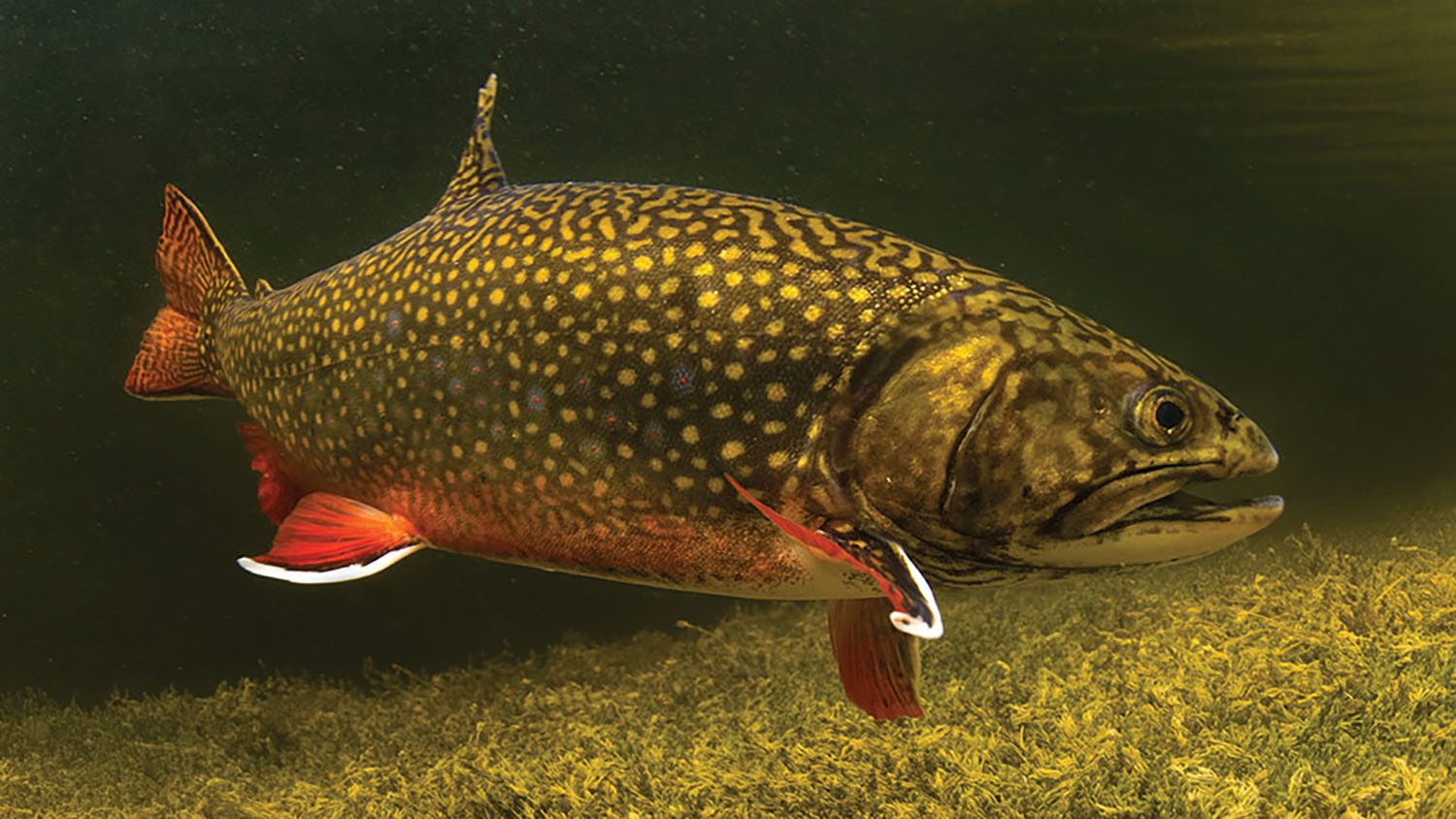
From Quebec south to the Carolinas and Maine west to Michigan, North American rivers and streams teem with brook trout. The official fish of 10 U.S. states, the brook trout has persevered across its broad native range over the centuries — despite threats from various industries, harmful land use practices and competitive species introduced into their habitats.
It’s a stout trout, but changing climates and increasing water temperatures pose a real challenge to a species that’s evolved to thrive in cold water.
The brook trout’s combination of presence, persistence and precariousness makes it ideal for studying how species adjust to shifting weather patterns. A new paper co-authored by NC State University applied ecologist Nadya Mamoozadeh probes the genetic foundations of brook trout adaptability and assesses which populations across the native range are most vulnerable to changing temperatures.
Risk and Adaptation
Southern Appalachian brook trout — those in the mountains of North Carolina, Georgia, Tennessee and West Virginia — are most susceptible to temperature fluctuations, Mamoozadeh and her co-authors write in “Range-wide Climate Risk and Adaptive Potential in a Cold-water Fish Species,” which appeared in Nature Communications in August 2025. These southern trout have a larger genomic offset, which is a measure of how much genetic change a population needs to adjust to new climate conditions, than brook trout in the Mid-Atlantic, Upper Interior, Northeastern and Northern regions.
The Southern Appalachian’s larger genomic offset is partly a reflection of the fact that its habitat is heating up faster than its peers’. But it also suggests a relative lack of diversity in today’s Southern Appalachian populations, a key indicator that future generations may not adapt fast enough to keep pace with warmer weather patterns.
“The greatest genetic change that’s needed to keep pace with the climate is here in the southern Appalachians,” says Mamoozadeh, an assistant professor and Extension specialist who joined NC State in 2024. “Our populations here have been small and fragmented for a while, and now they have another threat of warming water.”

Merging Observation, Experimentation and Practice
The study, co-authored with colleagues at Michigan State and Cornell universities, offered a rare opportunity to combine field assessments of brook trout across their native region with experiments conducted in lead author Mariah Meek’s lab at Michigan State. Typically, observation and experimentation happen separately.
“The real benefit of that is we could take what we learned from the controlled experiment and apply it across more than just those fish,” Mamoozadeh says. “That allowed us to hone in on which regions of the genome are involved in thermal adaptation.”
Next, Mamoozadeh wants to zoom in on the brook trout in the southern Appalachian region. Meek used fish from New York in her lab, and Mamoozadeh aims to replicate her work with populations closer to home.
Further study, she hopes, will inform preservation and restoration practices for government agencies, local anglers and the broad network of people working to protect native brook trout in North Carolina and neighboring states. Understanding the relationship between genetic diversity among brook trout and environmental changes, she says, could guide decisions about genetic factors to account for when adding to a dwindling population or modifying its environment.
“I care a lot about doing science that helps inform the conservation and management of these species,” Mamoozadeh says. “I want them to be on the landscape and present in our ecosystem and available for fishing opportunities from now into the future.”