Rethinking the Pollinator Garden
Horticultural science alumna Maegan Luckett focused her graduate research on how garden bed layout and plant selection impact bees and humans alike.
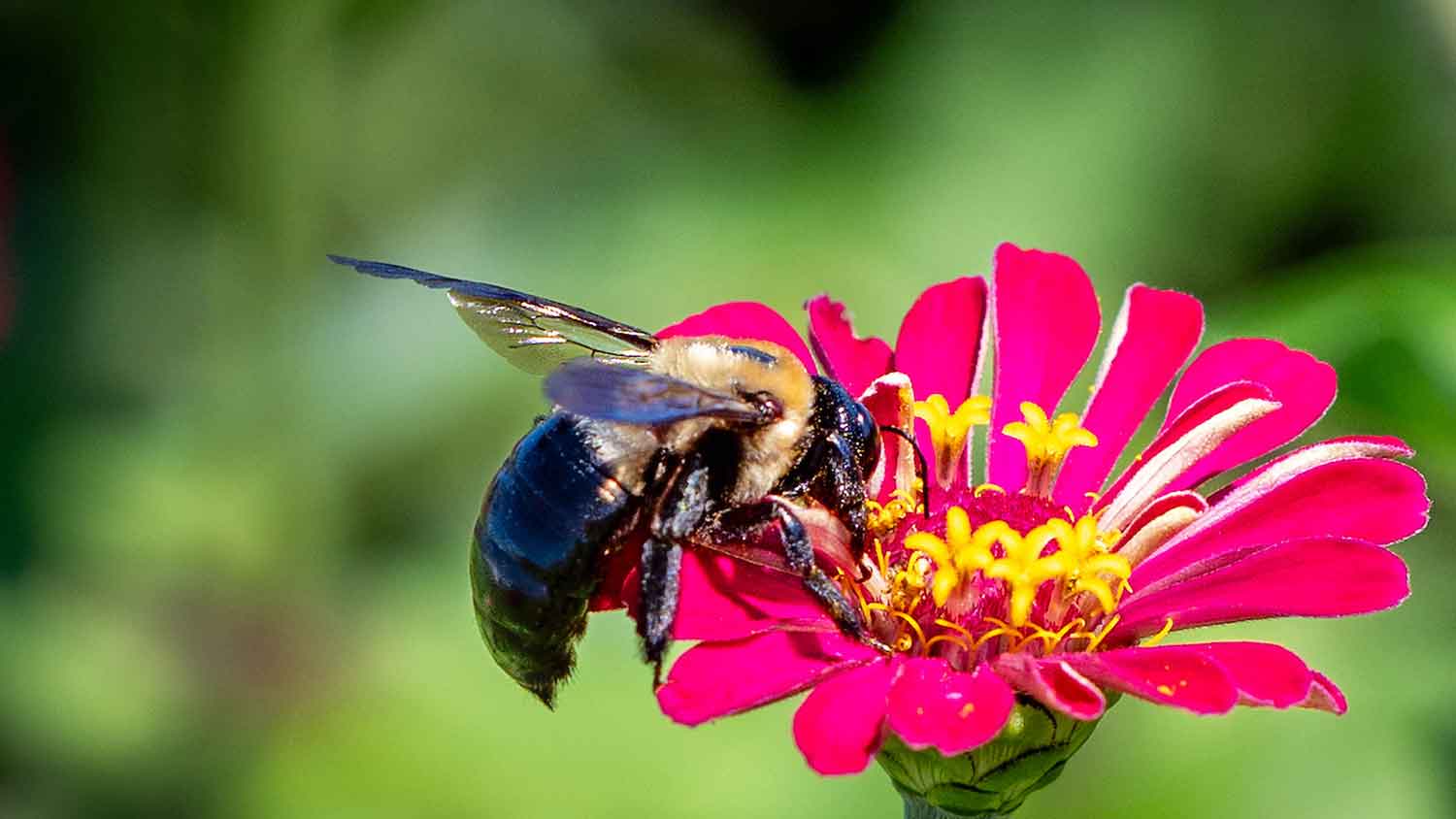
More than 75% of all flowering plants depend on pollinators for effective pollination, and one out of every three bites of food that humans consume is made possible by these insects. The process of pollination helps plants produce seeds, nuts and fruits that feed other wildlife, maintaining natural food systems.
As an alumna of the online Master of Horticultural Science program at NC State University, Maegan Luckett set out to examine how garden design impacts essential pollinators.
“In essence, I wondered if the way we design our gardens has a positive, negative or neutral effect on pollinators,” Luckett says.
Guided by Danesha Seth-Carley, an associate professor in horticultural science and director of the Center for Integrated Pest Management, Luckett studied how garden layouts can better support these species. She considered how thoughtfully designed flower bed layouts ensure there is always something in bloom from early spring through late fall, providing sustenance for pollinators throughout their entire active season. Furthermore, she explored how grouping similar plant species together also saves insects energy because they don’t have to travel as far between matching blossoms.
The Inspiration of Bees
While working on a garden crew as a teenager before starting college, Luckett had a transformative experience. She climbed into a blooming apple tree and found herself surrounded by a buzzing cloud of honeybees.
Like many children, she had been taught to fear bee stings. However, sitting high in the branches amid the busy worker bees focused solely on gathering nectar changed her perspective forever.
“It was a very magical moment where I was able to de-center my human concerns and just simply observe,” Luckett says. “Ever since then, I have been a huge fan of bees.”
This experience ignited a lifelong passion in Luckett for botany and horticulture. After spending nearly a decade working in the agricultural biotechnology industry in Research Triangle Park, Luckett, a Colorado native who has lived in North Carolina for nearly 20 years, transitioned into public horticulture.
Now a horticulturist at Blomquist Garden of Native Plants at the Sarah P. Duke Gardens in Durham, North Carolina, Luckett wanted to deepen her academic expertise while continuing her full-time job, so she enrolled in NC State’s distance master’s program.

She recently completed a four-year graduate research project exploring a question that bridges landscape architecture, entomology and human aesthetics: Does the way humans lay out flower beds help or hinder the pollinators visiting them?
Her research focus came naturally after a chance meeting with Seth-Carley, co-author of Pollinator Gardening in the South. The two bonded over their shared interest in native plants and insect conservation.
Luckett wanted to explore how garden design choices interact with a phenomenon known as “floral constancy,” a behavior in which individual bees repeatedly visit flowers of the same species on a single foraging trip, ignoring other rich nectar sources nearby.
“Because some pollinating insects exhibit floral constancy … I wondered if when we plant flowers far away from each other, does it make it harder for pollinators to get what they want and need,” Luckett says.

What You Plant Matters Most
To test her hypothesis, Luckett designed experimental garden beds using three distinct layout styles: massed plantings, flowing drifts and random distributions. Her findings offer reassuring news for home gardeners and commercial landscapers alike.
“Well, the good news for pollinators is that how you lay out your planting bed is less important than what you put in it,” Luckett says.
While her data showed a slight reduction in floral constancy behavior in randomly distributed plant beds compared to massed or drift layouts, overall insect visitation remained high across all three arrangements.
One plant emerged as the clear favorite among pollinators regardless of layout: Pycnanthemum tenuifolium, commonly known as narrow-leaf mountain mint.
“It was far and away the most attractive plant in the experiment,” Luckett notes.
Interestingly, human preferences diverged from conventional design wisdom. While traditional landscape design often favors deliberate masses or sweeping drifts, human survey participants in Luckett’s study unexpectedly favored the random, meadow-like distribution above the other choices.

Patience in Research and Distance Learning
Completing a master’s degree while working full-time in public horticulture required discipline, flexibility and patience. At one point, Luckett had to delay her field research by a full year because her experimental plot, located in a converted parking lot, needed more time to mature before attracting sufficient insect and human subjects.
“Grad school is stressful, full stop,” Luckett cautions prospective distance students. “For your own benefit, take time to do things that help ground and stabilize you because the rest of your life continues at full speed as well. I think the experience is better if you take your time.”
Now holding her master’s degree, Luckett hopes her research will empower everyday gardeners to make informed, ecologically friendly design choices. Looking ahead, she aims to advance her career into a curatorial role in public horticulture, with hopes of expanding her pollinator design research across larger spaces and longer timeframes in the future.
- Categories: