Teeing Up a Successful Career
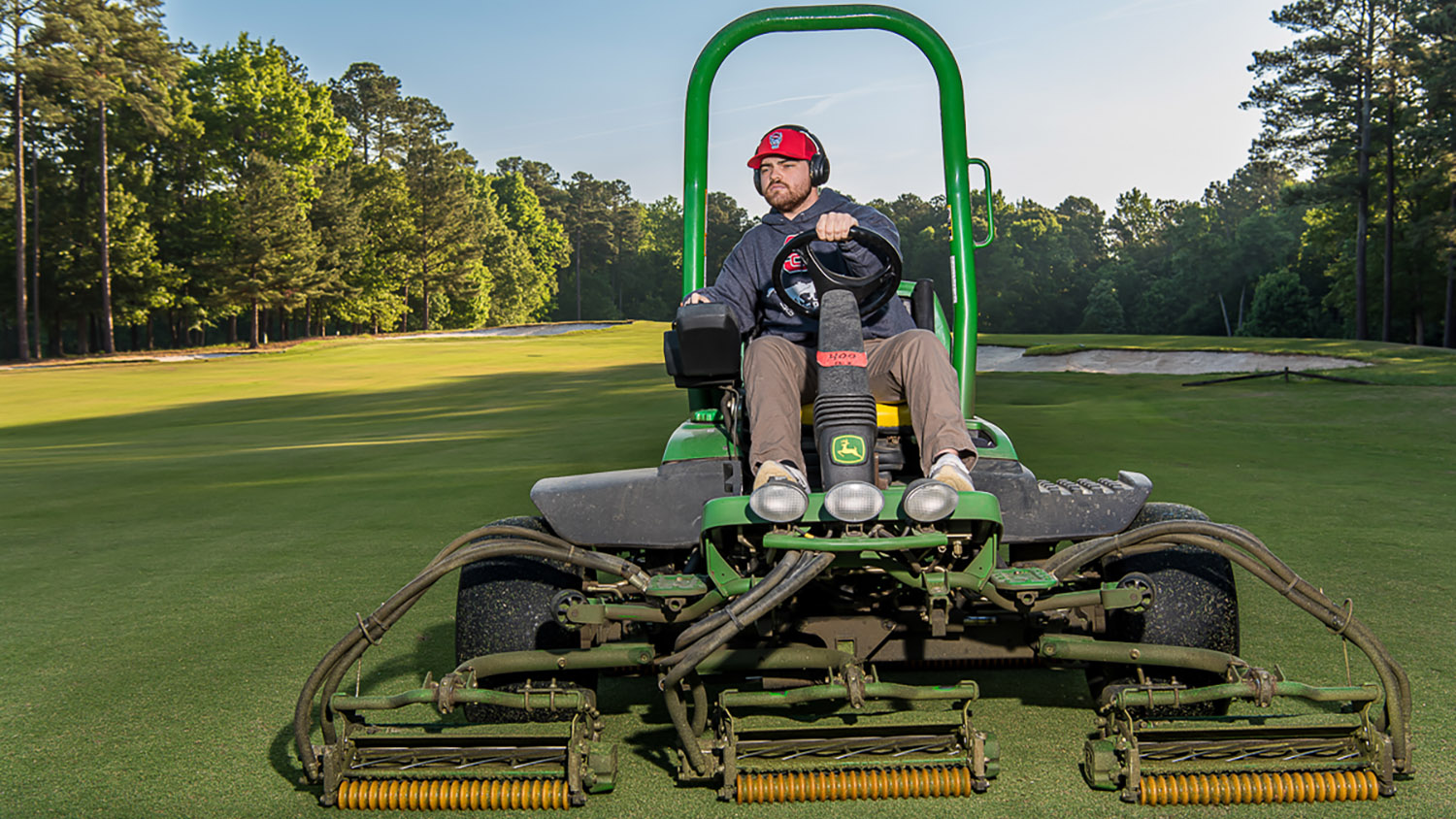
With a job already lined up at a new golf course near Aiken, South Carolina, Alex Boone, a turfgrass management major with the Agricultural Institute, is ready to hit the greens when he graduates in December.
By Lea Hart
Growing up in Canton, North Carolina, Alex Boone remembers tagging along with his dad to work on the golf course beginning when he was about 4 or 5 years old.
During those early mornings with his father, Jeremy Boone, then the golf course superintendent at Sequoyah National Golf Club, the two would wake up, grab a biscuit at the local gas station and then Boone would doze back to sleep for the 40-minute ride to the course.
Once there, he’d sweep out the maintenance shop or help pull soil samples. If he wasn’t working on the greens, he was playing rounds of golf with his dad and brother.
“I grew to love every part of it,” Boone says.
Two decades later, it’s clear Boone never lost that love. He played for the golf team in college at Emory & Henry University in Virginia where he earned a bachelor’s degree in business administration and management. But knowing a desk job wasn’t for him, Boone then signed on to earn a two-year associate degree in turfgrass management at NC State University’s Agricultural Institute (AGI), allowing him to turn his love for the course into a full-time career.
When he graduates in December, he’s already got a dream job lined up: helping grow in the turf for The Gilroy, a third course under construction at Old Barnwell, a private golf club near Aiken, South Carolina.
Building Experience
From those earliest days, Boone was never far from the golf course. At 16, he landed his first job working carts at a local golf club. Even then, he figured he’d end up around the golf industry in some form, perhaps as a sales representative calling on courses.
His senior year of high school and first year of college were during the COVID-19 pandemic. With many of his classes online, he continued working on the golf course — by that point, serving under his dad on the maintenance team.

The summer after his freshman year of college, Boone and his dad talked through his plans, and he knew he wanted to end up working full-time at a golf course.
“He technically fired me,” Boone says with a laugh.
In reality, his dad told him to go work somewhere else the following summer to learn from people outside the family. The two also talked through his options for turfgrass programs, and it came down to the Agricultural Institute, where his dad also attended, or an online program. Boone knew himself well enough to know he needed to be in a classroom, not behind a screen.
Understanding the Why
Even before graduating, Boone has already begun work at The Gilroy. He spent this summer working as first assistant, a role that has put him in charge of crew management, chemical applications and a long list of daily responsibilities. With 18 holes under construction and a planned October opening, Boone is putting what he has learned at the Agricultural Institute to work, helping build a golf course from the ground up.
“It’s almost like being thrown into the fire,” he says. “You never know what to expect.”
It’s the kind of head start the AGI is designed to give students. The institute, part of the College of Agriculture and Life Sciences, offers six two-year associate degree programs, including Boone’s turfgrass management degree, that combine classroom study with hands-on experience. Nearly three-quarters of AGI students have a job lined up before graduation, and 96 percent are working within six months of earning their degree.
For Boone, the institute has helped fill in the gaps from what he’d already learned growing up.
“I’d always worked on a golf course, so I knew how we did things — I just didn’t know why,” he says.
Coursework on topics ranging from pesticide safety to understanding the math behind calculating fertilizer application rates opened his eyes to the science behind the work.
One class in particular has stuck with him: a pesticides course taught by Terri Billeisen, which set him on the path to earning his pesticide license while still a student.
“She loves what she does, and it shows,” Boone says.
Now, when he spots an unfamiliar insect on a course, he can think back to her class and identify the pest.


Seeding Success
While at NC State, Boone also worked at the university’s Lonnie Poole Golf Course, under Brian Green, himself a graduate of the Agricultural Institute’s turfgrass program. The two compared notes often on how the industry and the institute have changed since Green’s time as a student.
“Brian isn’t afraid to put you on a job you’ve never done before,” Boone says of the mentorship that helped build his confidence handling unfamiliar tasks.
In addition to Green and his father, Boone has worked for three additional AGI graduates over the years – Ron Kelly, Chase Watson and Brandon Ingle.
Reflecting on his time in the program, Boone points to the ways the AGI helped him get ahead, such as earning his pesticide license — paid for through the institute.
“It sets you apart from other candidates,” he says. “A hiring manager would otherwise have to pay for that training themselves.”
After graduation, Boone will move into that full-time role at The Gilroy, with a goal of having the course fully dialed in within two years of its opening. Beyond that, he’s not sure exactly where the industry will take him, but he has a model to follow. His father is still in the industry 30 years later, now serving as the general manager and director of agronomy at Springdale Resort in Canton, North Carolina. Boone thinks he’ll likely become a director of agronomy or a general manager himself one day.
Looking back, Boone says he’s glad he wasn’t afraid to apply to a program like the Agricultural Institute.
“It’s not the long-term commitment that a four-year program is,” says Boone, who has experience with both. “Two years isn’t as big a time commitment as it feels like, and what you can do in those two years at the institute is amazing.”