Celebrating 60 Years of Biochemistry at NC State
The College of Agriculture and Life Sciences at NC State University is celebrating 60 years of biochemistry research, education and workforce development, with an eye toward advancing solutions in agriculture, medicine and beyond through interdisciplinary collaborations that empower students and faculty to Think and Do in new directions.
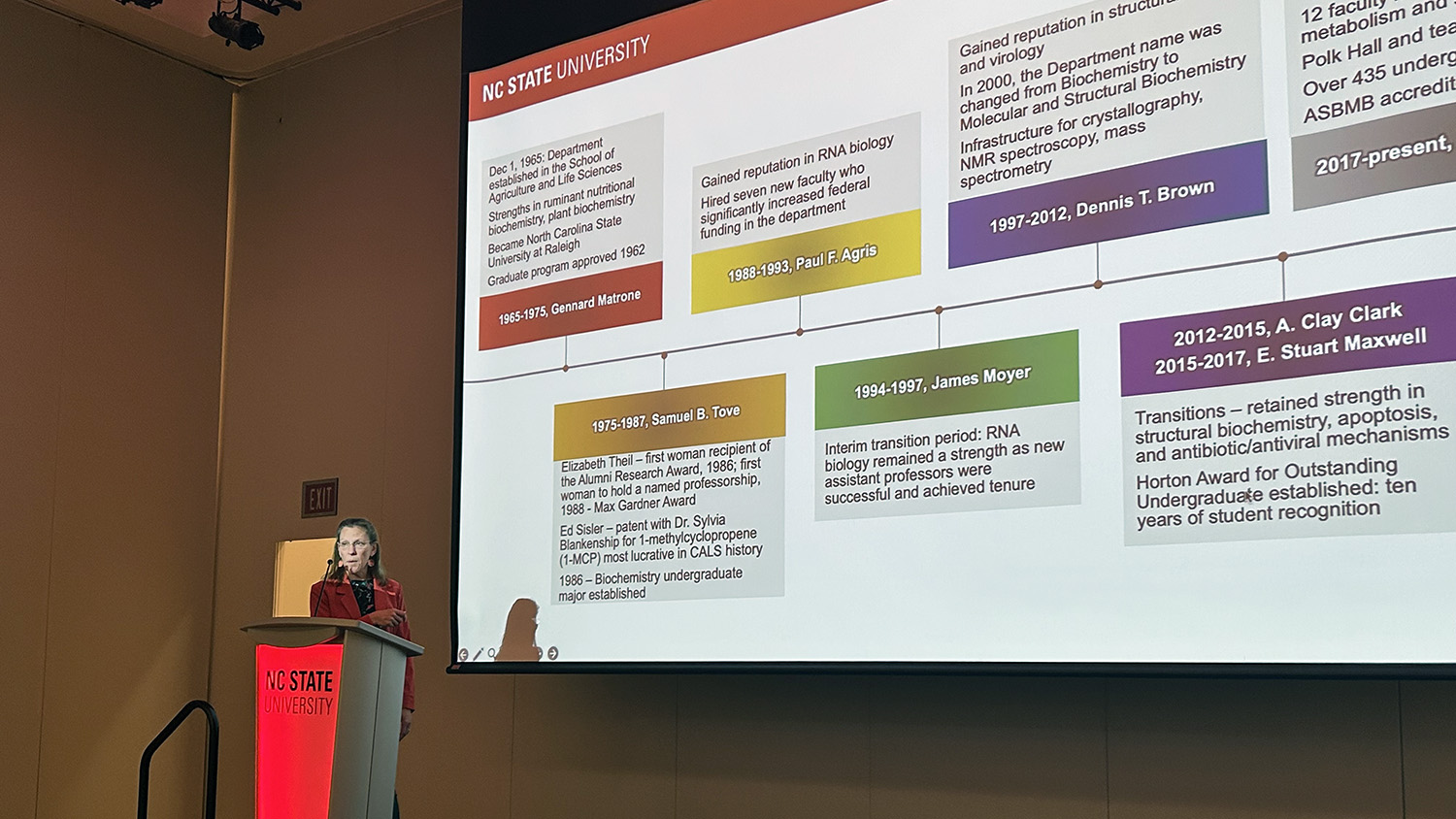
The history of the Department of Biochemistry at NC State and a celebration of its faculty, staff, students and alumni took center stage during the Gennard Matrone Symposium at the Talley Student Union on Nov. 14 in recognition of the milestone anniversary. The symposium is named in honor of Gennard Matrone, the first department head of biochemistry, in whose name an endowment was established to support a department lecture series.
Founded in 1965 with a focus on ruminant, plant and lipid biochemistry, the department later embraced new technologies like neutron diffraction, mass spectrometry and X-ray crystallography. It was renamed the Department of Molecular and Structural Biochemistry in 2000 to reflect its expanded research scope.
Today, faculty deliver a curriculum grounded in cutting-edge science, with research spanning from plant genetics to hormone therapies for human cancers. Collaboration is central to the department, with partnerships across campus, including the N.C. Plant Sciences Initiative, the Integrative Sciences Initiative and the Bezos Center for Sustainable Protein.
“What we have been able to do over the years is to really position ourselves as the epicenter of the life sciences in the college and at the university,” said Melanie Simpson, molecular and structural biochemistry department head.
And the dynamic nature of the department’s mission has led to rapid growth of its undergraduate student population in recent years.
“We have now over 435 undergraduate majors, so we have more than doubled in size in the last eight years, which is a tremendous accolade that is attributable to the faculty as well as our outstanding undergraduate advising and support,” Simpson said.
Many of the faculty reflected on how the passion of the students inspires their research and motivates them to empower the next generation of scientists.
“The real joy of the job is always working with students,” said Professor Tom Makris, whose lab focuses on the chemical biology of enzymes involved in pharmaceutical biosynthesis and bioenergy production. “The real catalyst of our research is the students.”
Future-Focused
For Varun Govindarajan, a sophomore biochemistry major, the department has allowed him to hit the ground running with hands-on research experience.
“I’ve been part of the lab since the summer before I actually joined NC State,” Govindarajan told the crowd of 160 people.
Working in the lab of Ryan Sartor, an assistant professor in the Department of Molecular and Structural Biochemistry, Govindarajan has focused on exploring how Lemna gibba, commonly known as duckweed, could potentially help mitigate excess nutrients, like phosphorus and nitrogen, in hog waste and then be used as a protein source for livestock.
With a long-term goal of applying to the department’s accelerated bachelor’s/master’s degree program and eventually earning a Ph.D. and a medical degree, Govindarajan wants to gain as much experience as possible early on in his academic journey to set him up for success in the future.

“My research experience has shown me how to apply this knowledge in real settings, teaching me problem-solving skills and helping me think critically and work independently,” Govindarajan added. “Together with the support of excellent professors and mentors, these experiences are guiding me toward my goal of becoming a medical researcher.”
Experiences like Govindarajan’s are the goal of the department’s Undergraduate Research and Training Program, which offers students from all majors and all experience levels an opportunity to work in a lab conducting real experiments. Under the leadership of Trino Ascencio-Ibáñez, an Outstanding Alumni speaker at the event and director of the department’s undergraduate programs and undergraduate research, the program has served close to 500 undergraduate students.
“We give them the tools so they can go and do great things,” Ascencio-Ibáñez said.
Collaborative Science
While the department has grown its enrollment and research specialties in recent years, it has long provided students with a supportive environment that nurtures their skills.
That was the case for Keith Gagnon, who earned his bachelor’s degree in biochemistry at NC State in 2003 and then his Ph.D. in biochemistry from the university in 2007. Early hands-on research proved transformational. His undergraduate and graduate work on RNA processing mechanisms guided him toward his current focus on RNA biology and CRISPR technologies. Now an associate professor of biochemistry at Wake Forest University School of Medicine, Gagnon develops therapeutic drugs using CRISPR and RNA sequencing.
He credits biochemistry professor emeritus Stuart Maxwell with shaping his work ethic and career interests.
“If I think back on my time in grad school, Stu instilled in us a passion, a desire — at least in me — to do exciting science, discovery science and do it the right way,” Gagnon said.


Similarly, Laura Herring, a research associate professor at the University of North Carolina and director of the Michael Hooker Metabolomics and Proteomics Core, credits her studies in the department with shaping her career. Herring earned her bachelor’s degrees in biochemistry and chemistry from NC State in 2007. After a three-year stint in the pharmaceutical industry, she returned to NC State and earned her doctorate in biochemistry in 2015.
With access to state-of-the-art mass spectrometry equipment and a host of opportunities for research, Herring recalled being able to explore the full depth of her interests.
“My main project was studying signal transduction pathways, treating cells with growth factor and looking at phosphorylation events,” she said, adding, “I had a lot of freedom in grad school and collaborated with so many people. All of that really helped my career.”
The support she received helped build the confidence and expertise that now guide her work in metabolomics and proteomics, researching biomarkers for diseases, metabolic pathways, and developing new treatments.
“The technical skills are important, but the relationships I’ve developed at NC State and at UNC really made it all worthwhile,” she said. “The best science happens through collaboration.”
- Categories: