Breeding Possibilities for Better Crops
By Amy Burtch
There’s a “think and do” mindset — and then there’s Caitlin Kestell.
Raised in the Midwest, she was taught from a young age that hard work is essential and was encouraged to raise her hand, to help other people and to never quit.
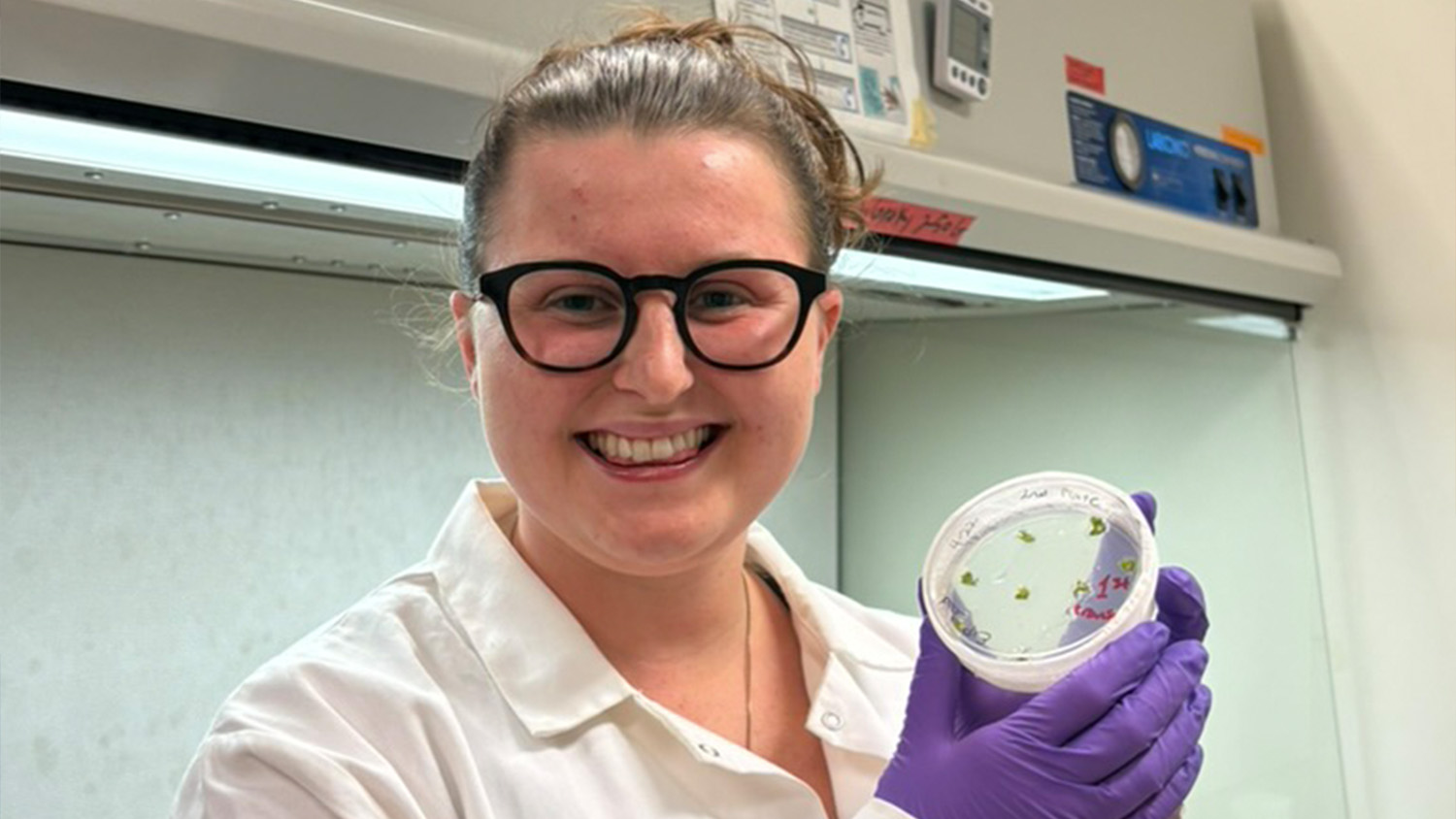
Kestell came to the College of Agriculture and Life Sciences at NC State University and thrived as a Genetics & Genomics Scholar in her first year. She now conducts research with Philip Morris Professor Ralph Dewey and participates in a variety of science outreach activities, like the North Carolina Youth Institute.
A crop science doctoral student, Kestell seeks to use biotechnology “to conquer huge problems,” including harnessing genome editing for crop improvement.
And she is well on her way to making that happen.
Discovering Biotechnology
Growing up in northern Wisconsin, Kestell saw corn fields everywhere. Her grandparents grew hay and alfalfa, but she only became excited about agriculture as a potential career when she discovered biotechnology at the University of Wisconsin–Madison.
“When I learned about gene editing in college, I was hooked,” Kestell says. “I could see myself pursuing a pathway like gene therapy.”
Kestell decided to pursue crop science and genetics at NC State because crop science “touches everyone’s life,” and she wants a career not only to support herself but also to benefit society. She considers farming “the biggest job on earth,” and wants to help.
Kestell appreciates the robust, collaborative plant science community at NC State, particularly her experience as a Genetics & Genomics Scholar. Offered to incoming fall-term Ph.D. students, this cohort-based graduate community provided Kestell with a one-year fellowship and introduced her to pioneering research across the life sciences. The courses she took within the program earned her a minor in Interdisciplinary Perspectives on Genes and Genomes.
The program included lab rotations, which Kestell says gave her more insight into different research areas and into working with principal investigators. In fact, this exposure led Kestell to join Dewey’s program and the Department of Crop and Soil Sciences.
“The overall focus was to learn about different types of genetics and genomes, consider ethics, support professional development and develop us as well-rounded scientists and people,” she says.


Advancing Agriculture Through Genome Editing
Now well into her doctoral research, Kestell works on hybrid breeding, which she sees as an essential part of agriculture. Hybrid breeding involves crossing together two elite lines, with the offspring line outperforming the parental lines. This is called hybrid vigor and results in increased crop yields and improved disease resistance.
“Basically, the offspring line is a superstar compared to the parental lines,” Kestell says.
A vital tool to producing hybrid seeds, she explains, is having male sterile plants. This trait is highly valuable to seed companies, which produce hybrid seeds to sell to farmers.
In Dewey’s lab, Kestell is helping develop a universal male sterility system for use in a variety of hybrid crops, noting the current limitations in rice and wheat. Using a combination of editing techniques, like CRISPR and meganucleases, she edits the mitochondrial genome while working on male sterility. The approach aids in creating hybrid seeds by preventing self-pollination and forcing cross-pollination.
Kestell’s enthusiasm for her research is palpable.
“It was so exciting to hold a seedless tomato that I made in my hand,“ Kestell says. “Now, I am working on a seedless sugar baby watermelon.”
Because of her research, Kestell earned scholarship awards from the N.C. Plant Sciences Initiative (PSI), funded by the Norma L. Trolinder N.C. PSI Graduate Student Endowment and the David M. Peele PSI Graduate Student Support Fund.
Kestell attributes her success to the support of Dewey, noting he is both an advisor and friend, someone who cares about her academic success as well as her personal growth.
“I am lucky to be partnered with an advisor who is so experienced and who cares so much about the students working with him,” she says.


Sharing Science Beyond the Lab
Perhaps one of Kestell’s greatest joys involves sharing science with younger students. She has served as a Howling with CALS summer camp counselor and as a volunteer at the Backwards Science Fair at Marbles Kids Museum in Raleigh.
Since arriving at NC State in 2022, She has participated in the N.C. Youth Institute (NCYI). Hosted by CALS, the N.C. Plant Sciences Initiative, NC 4-H and the Department of Crop and Soil Sciences, the program invites 100 high school students to develop innovative agricultural solutions to help solve global hunger.
In her role with the NCYI, Kestell helps students conduct research and draft papers. In April, she connected with the 2026 participants for their poster presentations and lab activities on NC State’s campus. Examples of the students’ food service projects include advanced irrigation techniques to improve Ugandan crop yields and lab-grown meat production.
“The high school students’ curiosity and interest in new things energizes me,” Kestell says. “I want to show them their research is novel and impressive.”
A Collaborative Spirit
With momentum building as she nears the completion of her Ph.D., Kestell is excited for the future.
NC State has taught her that science is a collaborative sport, and she looks forward to joining a professional team dedicated to using genome editing for crop improvement.
“NC State is about serving farmers and improving agriculture, and I will take that plus the spirit of doing science together into any company following graduation,” she says.