Plants on Defense
Researchers in the departments of Plant and Microbial Biology and Entomology and Plant Pathology are zeroing in on the genetic processes that underlie disease resistance in corn.
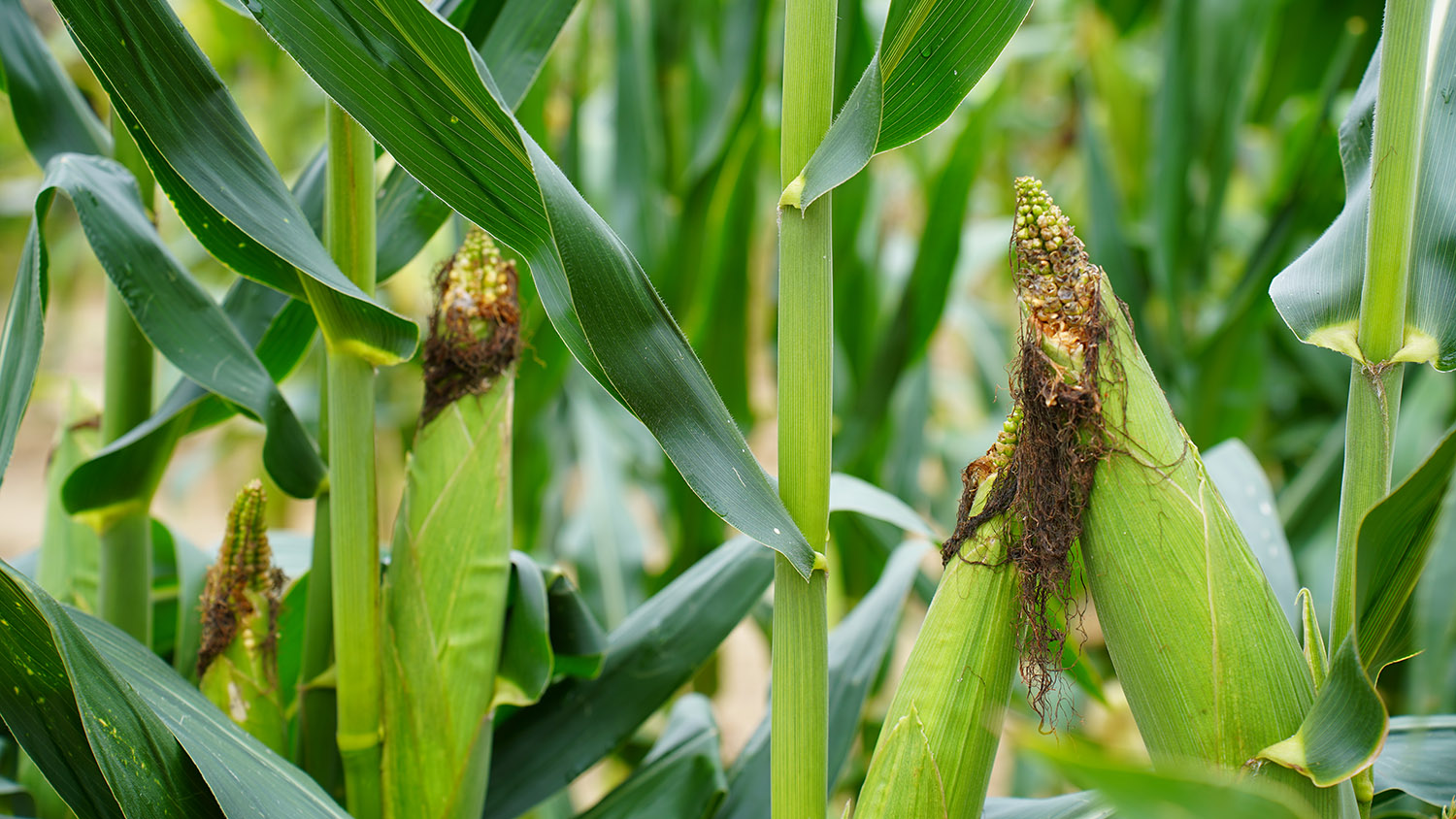
Drive down U.S. 70 toward Clayton, North Carolina, from Raleigh, and you’ll start to come across fields of corn, cotton and other crops not far off the road. While the Central Crops Research Station may look like one of the many farms you’ll find across North Carolina, it is one of 18 research stations supported by NC State University’s College of Agriculture and Life Sciences.
Among the many ongoing research projects there is a National Science Foundation-supported study focused on the genetic processes that underlie disease resistance in corn.
At the molecular level, plant defense begins within plant cells and the genes they carry. NC State Professor Terri Long, head of the Department of Plant and Microbial Biology, and Peter Balint-Kurti, research geneticist with the U.S. Department of Agriculture-Agricultural Research Service and adjunct professor in the Department of Entomology and Plant Pathology, are exploring one aspect of how this process works.
Growing Defense Systems

Just like animals, plants encounter pathogens and pests every day, ranging from insects and fungi to viruses and bacteria. In order to survive, plants need ways to combat pathogens and pests when they can’t physically move away from them. While some of these defenses are visible, like thorns and a thick waxy layer called a cuticle that pathogens must cross to infect the plant, others are far too small for the eye to see.
Wen-Yu Liu, a postdoctoral research scholar with the Department of Plant and Microbial Biology, was drawn to the project because of its real-world implications for mainstay crops like corn.
“What drew me to this topic is the fascinating challenge of understanding how plants defend themselves against disease at the molecular level,” Liu shares. “Maize is one of the most important crops in the world, and discovering how resistance genes are switched on and off, and what controls them, feels like genuinely meaningful science.”
The basis for the research began when Balint-Kurti’s team identified a protein, called an E3-ligase, that they believe is involved in slowing down the maize defense response. Long’s lab had also previously identified and characterized a similar E3-ligase that plays an important role in a plant’s response to low iron.
“While writing a grant proposal to fund continued work on this gene, I realized that it would be good to bring in an E3-ligase expert,” Balint-Kurti says.
From Lab to Field

So, what does an E3-ligase do? Imagine you are moving and need to sort the many packed things in your house. You might use color-coded tape or sticky notes to designate where items need to be moved to. Then, when the movers come, it’s easy to sort the many boxes and pieces of furniture that all need to go somewhere in your new place.
E3-ligases are the proteins responsible for adding those notes for plants by adding a small molecular tag to other proteins that tells the cell what to do with them. From their initial work in the lab, Liu and Balint-Kurti determined the protein acts as a brake for the corn disease response. The E3 ligase adds a tag that tells the cell to destroy an important component of the plant defense response, ensuring that it doesn’t run out of control and damage healthy cells.
Now they’re in the next step in their research, moving out of the lab and into the field. The researchers are looking at the impact of the E3-ligase gene in corn plants in which the defense response is too strong, causing lesions and tissue death across the plant.
“Now that the plants are growing, we’re scoring them … and collecting tissue for further molecular analysis back in the lab,” Liu explains.
It’s an opportunity to find solutions to ensure strong crop yields in the future.
“Working with Peter and Wen Yu on a major crop species has been an incredible experience,” Long says. “Translating our findings from the lab into the field is key to developing more resilient crops that can withstand real-world environmental pressures and secure future food production.”
A better understanding of how plant defense systems work and which genes are interacting within those systems will help plant breeders develop corn varieties with improved disease resistance. As Balint-Kurti puts it, “Our research suggests that this mechanism is quite general, used by a number of different plant species and modulating resistance to a number of diseases. Ultimately, we hope this knowledge will be of use in developing plants that can deal with disease more successfully.”