Building New Systems of Thinking

The challenges surrounding agriculture and food are complex, making it essential that the next generation of leaders in agriculture and food systems is prepared to address these issues with an understanding of the nuances tied to the food we eat.
That’s why faculty from NC State University have partnered with the University of Georgia, North Carolina Agricultural and Technical State University and the University of Minnesota to develop new curriculum tools to help undergraduate students at land-grant universities think more expansively about the complexities within agriculture and related fields. Funded through a five-year Higher Education Challenge grant from the U.S. Department of Agriculture’s National Institute of Food and Agriculture, the initiative, known as STEPS (Systems Thinking for Educational Problem Solving), aims to equip students with the skills to better evaluate all facets of a problem and the impacts of potential solutions. The project is led by principal investigator Kevan Lamm at the University of Georgia.
“Systems thinking is really about how we can anticipate unintended consequences that happen when we make a decision,” says Katie Sanders, an assistant professor in NC State’s Department of Agricultural and Human Sciences, who is among the faculty members working on the project.
Based on real-life situations drawn from food-related topics, the curriculum tools will feature nine interdisciplinary “choose-your-own adventure” scenarios to use in undergraduate classrooms.
Sanders, who also serves as an Extension specialist in food systems communication, says the lessons tackle three types of challenges: the overuse of a common resource, accidental adversaries and fixes that backfire. The scenarios focus on trends in controlled environment agriculture, animal production systems, and community health and food systems.
No Right Answer
The goal behind the tools, says Sanders, isn’t to guide students to a “right answer.” It’s to have them view a situation, such as building a community garden from scratch, from many different angles.
Sanders and Annie Hardison-Moody, a professor of agricultural and human sciences and an Extension specialist at NC State, have developed the scenarios for community health and food systems, and are spending much of the 2025-26 academic year testing the tools in classes in NC State’s College of Agriculture and Life Sciences.
This fall, Sanders tested the lessons in three CALS classes, including Introduction to Nutrition Research, Communication and Careers, where students had to weigh solutions for the following scenarios:
- Turning a vacant lot into a community food resource, choosing between using initial funding immediately for a farmers market or a community garden or conducting outreach and fundraising first to develop a community-based option.
- Endorsing a new PTA president, choosing between a dietitian or a local health influencer and their stances on removing seed oils or artificial food dyes from school lunches.
- Managing a community kitchen, balancing schedules of 4-H volunteers and farmers and challenges around availability.
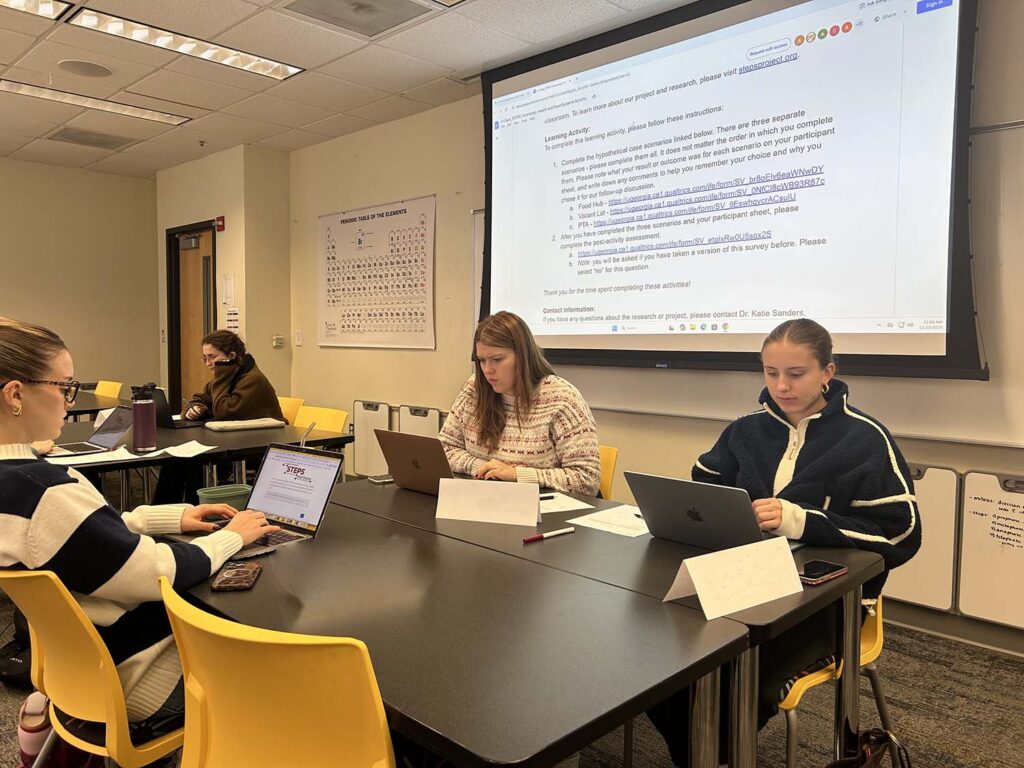
None of the scenarios provided a definitive winning strategy, and that’s by design.
“When you’re making a decision, it does not happen in a vacuum, and the impacts are not isolated,” Sanders says. “But a lot of our students, when they get to the undergraduate classroom, are often primed for black and white thinking, correct and incorrect answers. And when they’re presented with our curricular tools, what they find out is that there is no right answer, and that’s deeply uncomfortable for them.”
During the nutrition class, students had to choose between imperfect solutions, each of which came with problems such as dwindling interest, rising costs or coordination challenges. One student described the choices as “all having downsides.” Another reflected that the exercise was “really frustrating because … in the end there were consequences that led to impacts on other people, and I think it’s reflective of how difficult it can be to address these issues when the factors involved are very complex.”
A New Crop of Curriculum Tools
Natalie Cooke, associate professor of nutrition science, whose class was among those to test the scenarios, says having tools that help students wrestle with multilayered issues in agriculture and food systems opens a gateway for deeper student engagement.
“The design of these curricular tools allows for small- and large-group discussion about systems thinking, which can help students connect with others while articulating their thoughts on complex topics they may encounter in their future careers,” Cooke says.
The lessons the project ultimately produces will be available online for faculty at any U.S. land-grant institution to use in undergraduate classes in a variety of courses. The intent is to provide students with opportunities to explore interdisciplinary issues in greater depth and leverage the best of each discipline to solve problems.
“In my experience as an educator, I think it’s a great lesson in humility that we can’t know all the answers, and we’re better when we have a broader team and can build on other people’s expertise, perspectives and experiences,” Sanders says.