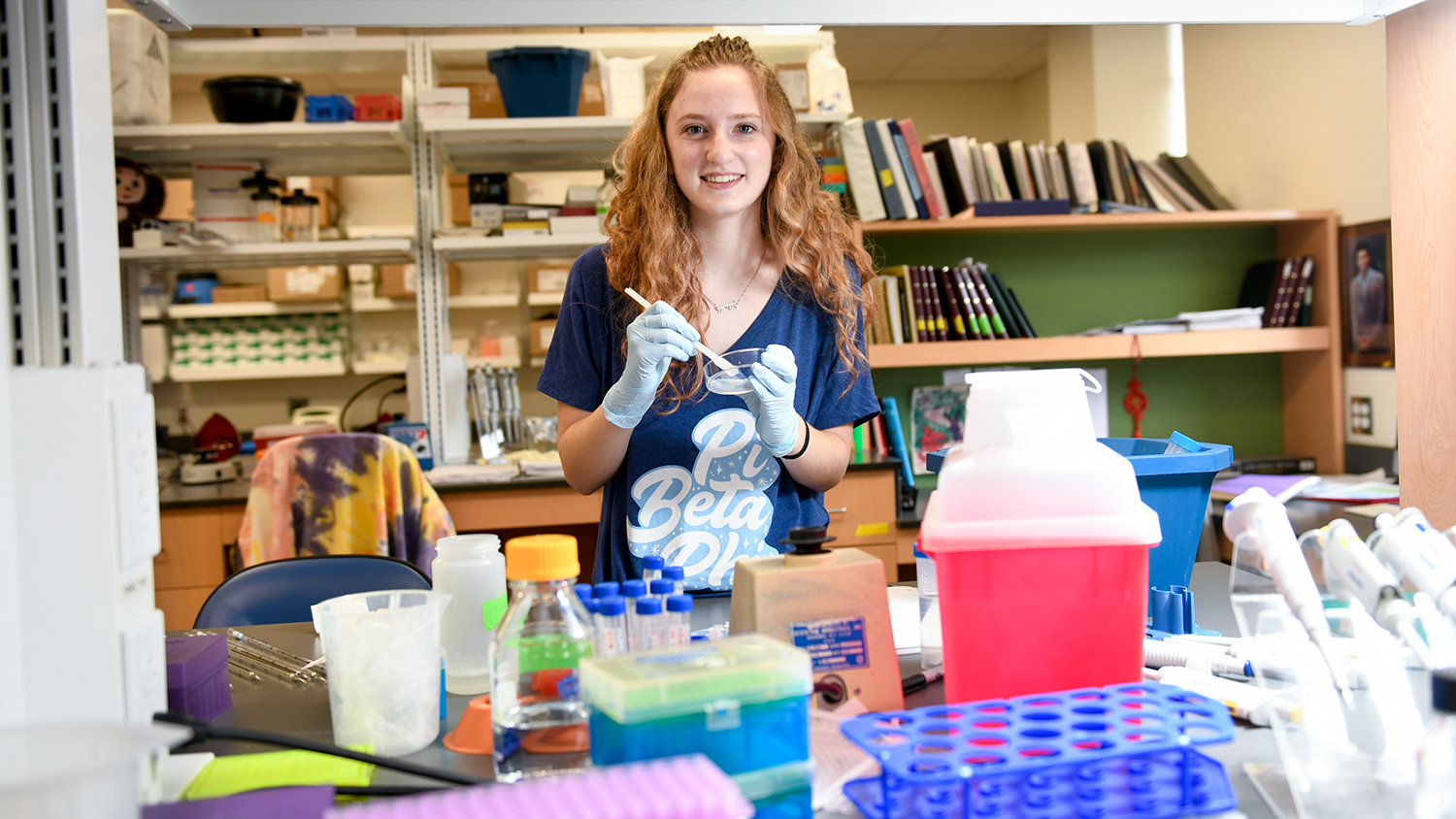
The accelerated bachelor’s/master’s degree program (ABM) provides biochemistry undergraduates the opportunity to complete the requirements for both degrees on an accelerated schedule.
Students can count 12 credit hours toward both B.S. and M.S. degree requirements. Consequently, only 18 credit hours must be completed as a graduate student. Students can complete the dual degree program in about five years. See full details about the accelerated bachelor’s/master’s degree in the Biochemistry Graduate Student Handbook.
Requirements
Admissions
- A minimum of 75 credit hours in the undergraduate program, including credits earned from advanced placement, but before completing the bachelor’s.
- A minimum overall 3.5 GPA in undergraduate work at NC State at the time of admission into the Master’s program.
- Receive a grade of B or better in the double-counted graduate-level courses (500 or 700 level) while maintaining a 3.5 GPA. (Courses with a grade of B- or below cannot be double-counted between the two degrees.)
- Maintain a 3.50 GPA or better in biochemistry major.
- Be positioned to complete the B.S. degree requirements by the end of the fourth year, and formally apply for admission to the Graduate School.
- In consultation with your undergraduate advisor, complete a Program of Work that will fulfill your course requirements. This must accompany your Graduate School application. Consult with your undergraduate advisor to complete this form using these guidelines.
- One letter of recommendation from the proposed faculty mentor, indicating the qualifications of the student and their willingness to serve as the master’s advisor.
- A concise, two-page master’s thesis prospectus, focusing on presenting the essentials of your research proposal, should be included in your application.
Course Requirements
In addition to the standard university and biochemistry requirements for a B.S. in biochemistry, students must complete 30 credit hours at the graduate level for the master’s of science degree component outlined below:
- Undergraduate courses (12 credit hours):
- 6 credit hours total of 500-level courses in BCH*: BCH 553 (3 cr) and BCH 555 (3 cr)
- 6 credit hours of 400-level courses with a 500-level counterpart *: For example, BCH 552 (grad equivalent of BCH 454). Non-BCH courses examples include BIT410/510, GN421/521, GN441/541, etc. When possible, enroll in the 500 level component.
* Indicates courses double-counted for both the bachelor’s and master’s degrees.
- Required graduate courses (18 credit hours):
- 12 credit hours of 500/700 level courses: BCH 590** (3 cr), BCH 701 (3 cr), BCH 703 (3 cr), and BCH 705 (3 cr).
- 6 credit hours of Research/Scholarship/Education: BCH 695 (6), BCH 693 (6), or BCH 685 (6)
- If your schedule permits, students are encouraged to complete 6 credits in their final year as an undergraduate.
** *May substitute another graduate level course (500/700 level) if cannot accommodate BCH 590 in schedule. Includes CHM 727, GN701, BCH/GN761, MB714, MB718, PO 757, etc.)
Thesis Requirements
ABM program students will present original research and evidence of mastery of biochemical techniques. A research prospectus must be submitted for approval to the proposed graduate thesis committee no later than the penultimate semester of your undergraduate degree. The candidate should present the thesis as an original scientific manuscript, suitable for publication in a scientific journal. To complete a significant body of work to include in the thesis, students should identify a faculty mentor while completing the undergraduate degree requirements. We recommend students make these decisions no later than the end of their junior year, but preferably sooner to meet the accelerated schedule.