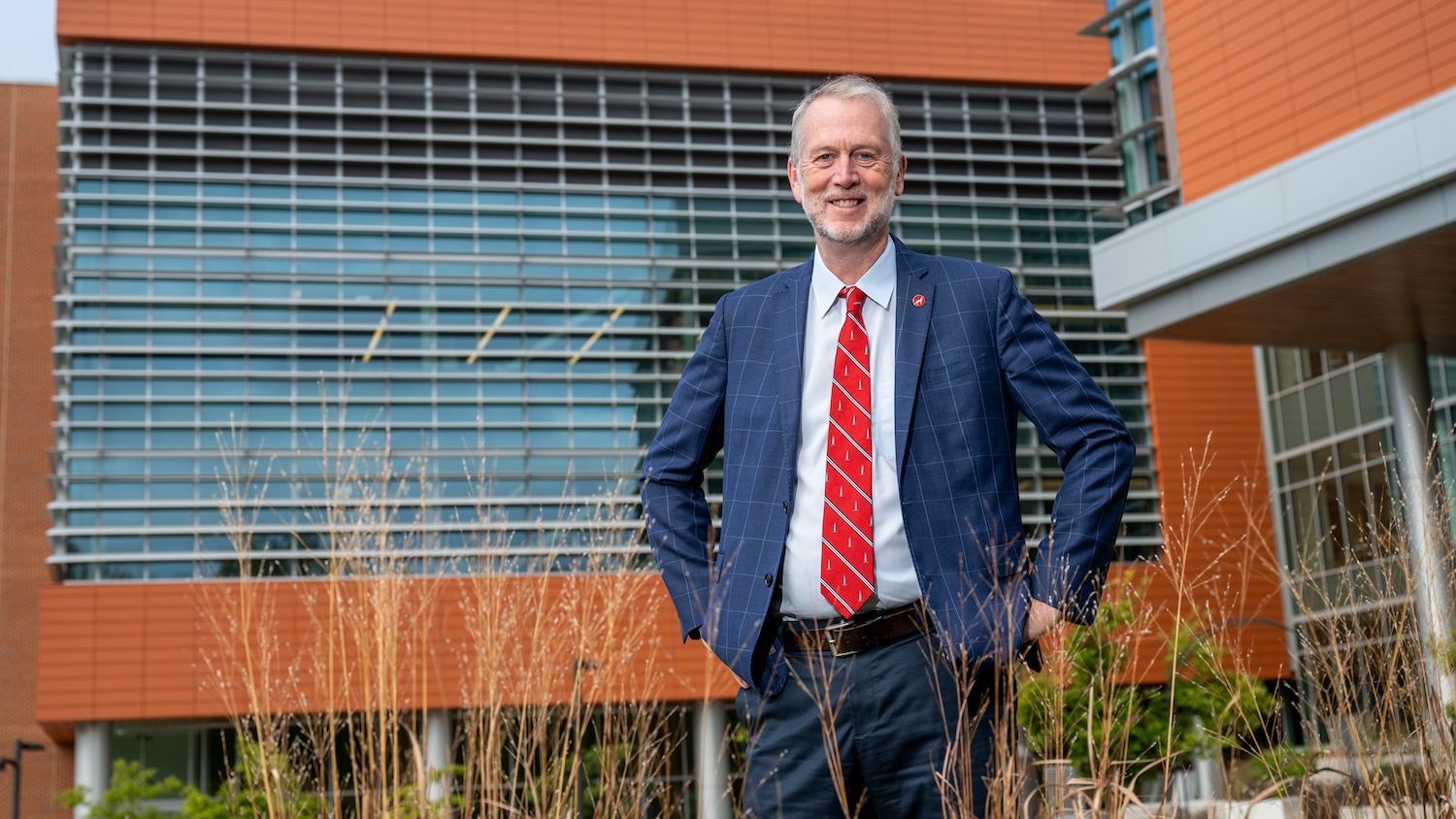
From the Ground Up
Originally from Ghana, Rashid Imoro saw firsthand the impact soil quality has on crop yield and productivity. Coming to NC State as a doctoral student with Alex Woodley has helped him better understand how different amendments can improve soil quality.

Raised among farmers in northeastern Ghana, NC State Ph.D. candidate Rashid Imoro has spent the past three years testing whether popular soil amendments really deliver on their promise. His answer: It depends on the soil.
Imoro grew up in Janga, a farming town in northeastern Ghana, where the land decided how well a family ate. Working alongside his parents in the crop fields and with livestock, he noticed early that the same crop could thrive in one field and struggle in the next. The difference, he came to realize, was in the soil.
“Soil is really at the center of food production, water management, environmental quality and ecosystem health.”
“Agriculture was something very huge,” he says of his hometown. “I have seen how resource limitations can affect people’s daily lives, particularly around agriculture and water. That gives my research a personal dimension. My parents are farmers, so I’m a farmer.”
That curiosity has carried him from Ghana to Scotland, England and, finally, to the research fields and greenhouses of North Carolina State University. Imoro expects to complete his Ph.D. in soil science in December 2026, and he plans to turn what he has learned into practical solutions for farmers and land managers.
“Soil is really at the center of food production, water management, environmental quality and ecosystem health,” he says.
A Path Rooted in Agriculture
Imoro studied agriculture in high school and went on to earn a bachelor’s degree in agriculture, specializing in crop and soil sciences, from Kwame Nkrumah University of Science and Technology in Kumasi. After graduating in 2017, he spent several years teaching agricultural science, first at his alma mater as a teaching assistant and then as a high school tutor in Bimbilla.
“My purpose of studying agriculture was actually to understand the agricultural processes, to be able to investigate problems and find lasting solutions.”
His research interest then took him to the University of Aberdeen in Scotland, where he earned a master’s degree in soil science in 2022.
Through it all, he kept returning to one goal.
“My purpose of studying agriculture was actually to understand the agricultural processes, to be able to investigate problems and find lasting solutions,” Imoro says.
To do that, he decided he needed a Ph.D.
“That is where I will learn in detail the broader scope of solving problems, understand them, investigate them and find solutions,” he recalls thinking. “And that led me to NC State.”
He already had a specific mentor in mind. As a student, Imoro had read research papers by Alex Woodley, now an associate professor in the Department of Crop and Soil Sciences and a faculty affiliate of the N.C. Plant Sciences Initiative (N.C. PSI). “‘This guy must be an interesting person to work with,’” he remembers thinking.
Imoro applied twice to join Woodley’s Sustainable Soils lab before the door finally opened. He arrived in Raleigh in December 2023 and began his doctoral program the following month.
Do Soil Amendments Deliver?
Imoro’s dissertation asks a question that matters to farmers, policymakers and the growing carbon-credit market: Do soil amendments actually improve soil health and store carbon under North Carolina conditions?
Amendments are materials added to soil to change its properties. They are often promoted as a way to boost soil health and fight climate change at the same time.

Imoro studied four amendments:
- Biochar is a stable, carbon-rich material made by heating organic matter to high temperatures with little or no oxygen, a process called pyrolysis. Because its carbon resists breakdown, biochar can stay in soil for centuries. Imoro worked with three biochars, made from oat hulls, softwood and used railroad ties.
- Basalt rock dust is finely ground volcanic rock, often a byproduct of quarrying. As it weathers, it draws carbon dioxide out of the air and releases nutrients such as calcium and magnesium. Spreading it on cropland to speed up that process is known as enhanced rock weathering.
- Compost is decomposed organic material, such as food scraps, leaves and manure, that adds both carbon and nutrients to soil.
- Cover crops are plants grown between cash crops to protect the soil and return carbon to it through their roots and residue.
The challenge is that most of North Carolina’s farmland sits on old, heavily weathered soils that hold nutrients poorly and contain little organic matter. Imoro designed his experiments around contrasting soil textures, from heavy Piedmont clays to sandy Coastal Plain soils, because he suspected texture would decide whether an amendment helped or not.
“I chose this topic because biochar and related amendments have the potential to address several problems at the same time: improving soil properties, retaining nutrients, increasing carbon storage and potentially reducing environmental losses,” he says.
“Soil type, amendment characterization, moisture conditions and the way the amendment is applied can all influence the outcome.”
In studying biochar created from used railroad ties, Imoro conducted a greenhouse experiment, a laboratory incubation and research at two field sites where amendments had been applied five years earlier. A single theme emerged: The soil, not the amendment, sets the outcome.
“Soil type, amendment characterization, moisture conditions and the way the amendment is applied can all influence the outcome,” he explains.
The practical message, he says, is that amendments should be matched to the soil and applied at rates the soil can hold, not at one fixed dose everywhere. Three papers from the work are currently under review at scientific journals.
To make the greenhouse gas measurements possible, Imoro also built his own equipment. He engineered a low-cost Raspberry Pi multiplexer that automates nitrous oxide and carbon dioxide monitoring, cutting instrumentation costs while producing data precise enough to support carbon-credit verification.
Beyond the Research: Part of the Plant Pack
Imoro says his time at NC State has shaped him as both a scientist and a person.
“I’ve had the opportunity to conduct research across the field, the greenhouse and the laboratory, present my work at scientific conferences, publish research and work with people from different disciplines,” he says.
He also found his voice as a teacher when he instructed the laboratory section of the introduction to soil science for two semesters. Outside the university, he has mentored high school students through the North Carolina Youth Institute, associated with the World Food Prize Foundation, and led hands-on science activities for K-12 students at the N.C. Museum of Art. In 2026, he also became a Nutrient Management planner in North Carolina after taking the required courses.

In 2025, he won fourth place for an oral presentation at CANVAS, the annual meeting of the Agronomic Science Foundation, the American Society of Agronomy, the Crop Science Society of America and the Soil Science Society of America, in Salt Lake City, and third place for a poster contest at the Southeastern Biogeochemistry Symposium.
This year brought his biggest honor yet. Imoro was one of eight scholars nationwide named a 2026 Bridge Scholar by the agronomy, crop science and soil science societies. The award pairs each scholar with an established scientist for one-on-one mentorship, opens doors to professional development workshops and industry connections and funds his participation in this year’s CANVAS meeting in Portland, Oregon, in November.
“And I think … interdisciplinary research relationships are extremely important for the kind of scientist I want to become.”
As part of the N.C. PSI’s Plant Pack, Imoro works alongside researchers in plant science, genetics, breeding, environmental science and engineering. That daily contact has shown him how interconnected agriculture is. Each person brings a different passion, he says, but they are all working on the same problem: how to produce food sustainably.
“The Plant Sciences Initiative creates an opportunity to interact with people outside of my immediate research group,” he says. “And I think those interdisciplinary research relationships are extremely important for the kind of scientist I want to become.”
What’s Next
After graduating in December, Imoro’s first stop will be home. He has not been back to Ghana since arriving in Raleigh, and he is eager to see his parents.
After that, he hopes to work where soil science, environmental management, agricultural sustainability and water meet. Growing up, he learned that a harvest depends on having enough clean water, and that lesson still shapes how he thinks about his research.
A career as a professor or research scientist would let him keep doing research while carrying what he learns to farmers and land managers.

Publishing papers matters, he says, but he “wants to become a scientist and educator whose work has an impact beyond academic publications.”
He measures success less by personal achievements than by the lives his work touches and is open to wherever that path leads. If the right opportunity comes in the United States, he will stay. If it comes in Ghana, where his work could directly help his own community, he will gladly go home.
“For me,” he says, “success would be being able to say that my research, my students, my work … have made agriculture and natural resource management a little more sustainable and improved people’s lives.”