
WRITTEN BY: Matthew Burkhart (mkburkha@ncsu.edu)
Two CALS Students expanded their academic horizons and cultural knowledge during a transformative summer research experience at Nagoya University in Japan.
Julia Yurkiv and Riley Keely, both biochemistry majors, were selected for an international research program that combined advanced scientific work with rich cultural immersion. For Yurkiv, the opportunity to study abroad had been long overdue. She wanted a program that fit her summer schedule without the commitment of a full semester overseas, and her research interests made Nagoya’s offerings a better fit than other options, including one in Spain.
Yurkiv said she selected the program after exploring various summer research opportunities available through CALS.
CALS.
“I just wanted to study abroad somewhere, but I didn’t want to do it for a whole semester,” Yurkiv said. “I also wondered what opportunities there were in CALS. One was to go to Spain and do some research or Japan. I think the projects in Japan suited my style, at least in biochemistry, more than Spain”.
Keely was invited by Yurkiv to join the program and hesitated initially, citing challenges with scheduling and tuition costs.
“Julia found this, and then she was like, Riley, you must come with me. And I was like, I’ll think about it. Maybe if I get money for it, because I also was like, there’s no room in my semester for this — that’s just unrealistic.”
Keely added that the feasibility of doing summer research made it possible.
“I’m not going to be paid to do research for the summer here anyways, so I might as well keep doing research because I enjoy it, and that’s what I want to do,” Keely said.
At Nagoya, Yurkiv joined a plant pathology lab where she investigated gene pathways in a model organism to understand how genes regulate different biological processes in plants. Her project involved identifying genes that could switch metabolic pathways, a process still unknown in the species she studied. While laboratory techniques were familiar, Yurkiv said that the project emphasized molecular-level understanding, which was new to her.
Meanwhile, Keely’s work differed from her usual experience, focusing on animal culture with insects and sophisticated microscopy techniques. She found the lab culture distinct from her experience at NC State, with regular lab meetings where students presented progress and received feedback from peers and professors. This environment fostered communication and collaboration, which Keely found valuable.
Outside of the lab, cultural immersion began as soon as they arrived. After a 30-hour journey, navigating Japan’s transportation system posed its own challenges.
“We did not want to navigate the subway. That was our first mistake. But we were pretty tired, so we took a taxi. It was like a 40-minute ride,” Yurkiv said. The experience pushed them to quickly master the subway system, which made travel much easier.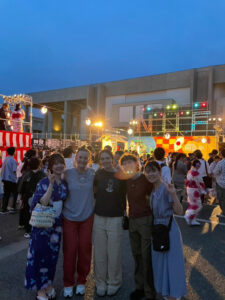
Once settled, they explored Nagoya’s vibrant culture and historic sites. Everything from restaurants to shopping was within walking distance, Yurkiv said, and weekends included visits to shrines, museums and Nagoya Castle before they fully settled in to their research.
Both students were struck by the warmth and kindness of the people they met, as well as the international atmosphere on campus. Keely was impressed by the number of students from around the world and by Nagoya University’s reputation.
“It’s a competitor with Tokyo University, one of the top universities, and several Nobel Prize winners went there,” Keely said. “They had little mini museums celebrating them. I went to those, and of course, they were in science. I was geeking out.”
 For Yurkiv and Keely, the program became more than research. It allowed them to build lasting friendships and gain perspective. Saying goodbye was difficult for Yurkiv.
“The friendships… it was hard saying goodbye. It was because we actually made a lot of connections at the end,” Yurkiv said.
They also reflected on cultural differences. Yurkiv admired Japan’s collectivist mindset, where decisions emphasize the common good over individual gain.
“I know they’re more of a collectivist society than being an individualist, like they benefit what will benefit the group more than just myself. That’s really cool.”
Keely noted Japan’s diligence with environmental practices, particularly its detailed waste management system.
“Their trash system is like, I need a curriculum for it. It was so elaborate,” Keely said. “It was really funny. But it was also so lovely to see that it is possible, maybe if you didn’t have such a pessimistic attitude, and actually cared.”
Both students said the experience also carried prestige.
“When we told them we were Nagoya students, they said, ‘Oh my gosh, you’re so smart,’” Keely said. “We had some kind of prestige when we were there. Wherever we went, we were actually studying, doing research.”
Both students encourage future NC State peers to take advantage of international opportunities. They believe stepping outside comfort zones in both academics and culture provides skills, perspectives and relationships that last far beyond graduation.