I Am CALS: Justin Page
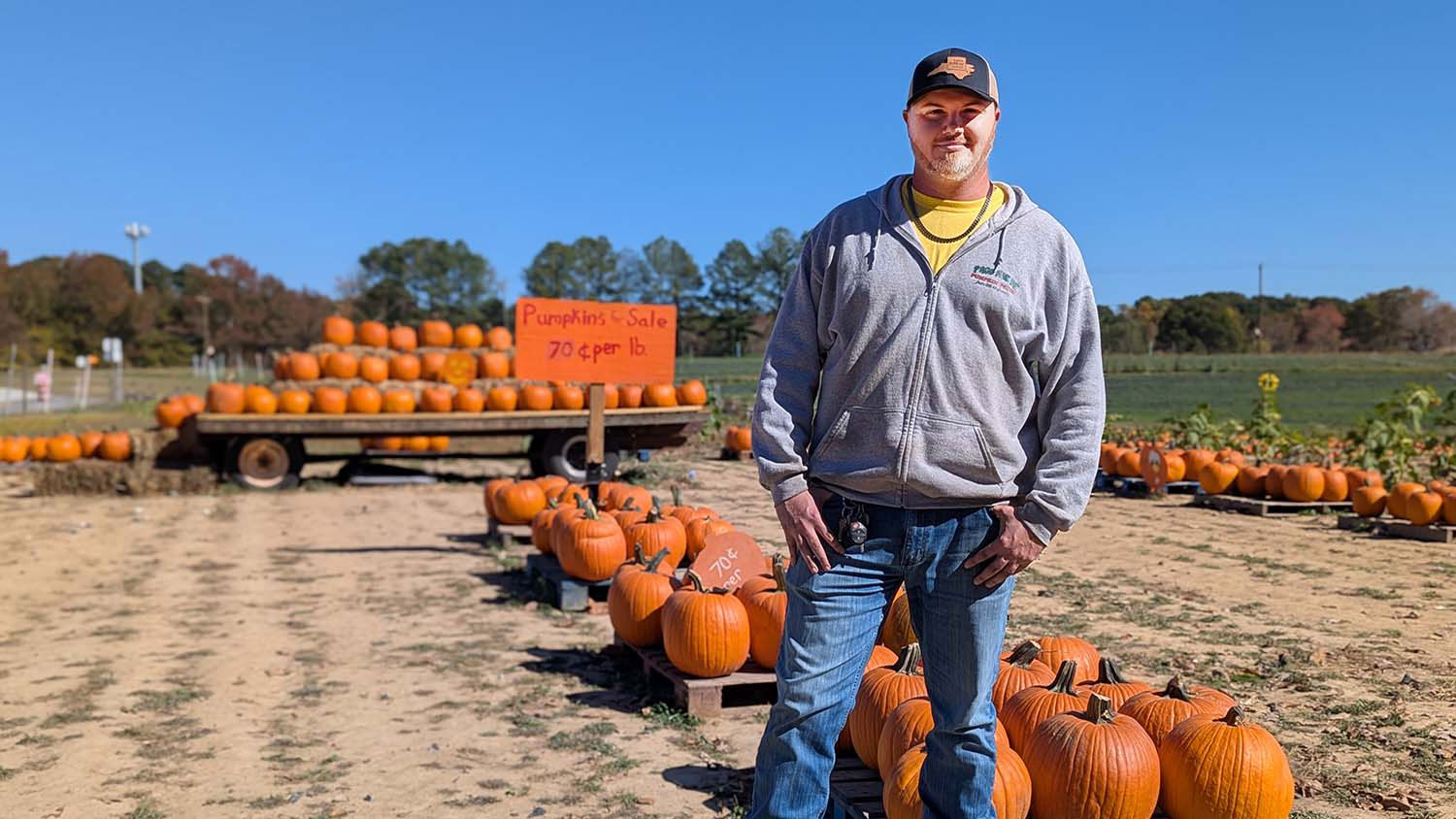
By Lara Ivanitch
As reliable as homework, each fall teachers at the grade schools Justin Page attended asked, “What did you do this summer?” While classmates spoke of family trips and beach vacations, Page’s response — “I sat at the back of a pickup truck selling corn the whole time” — was always met with blank stares.
“No one I went to school with had a clue what I was talking about,” says the fourth-generation farmer. “We just worked all summer long.”
Before becoming an agricultural attraction, Wake County’s Page Farms grew tobacco. Nearly 20 years ago, Page’s father found he couldn’t make the same money growing the golden-leaf crop after the tobacco buyout and sought a new focus.
“My dad started transitioning to more of the agritourism side of things with strawberries, and we added in pumpkins in 2010,” he says.


The farm’s location — tucked among Raleigh, North Carolina’s, sprawling Brier Creek community — lent itself to success. Today, you-pick makes up 95% of the farm’s strawberry crop, and its fall pumpkins and attractions draw 15,000-20,000 visitors each season.
As a young teen, Page didn’t mind helping with farm chores. “I was a kid being allowed to drive a giant tractor. In my mind, I’m like, what better else could I do?”
When it came time to consider careers, there was no question that Page would do something in agriculture. His road to the College of Agriculture and Life Sciences at NC State University, however, was indirect. Despite reasonably good grades, he wasn’t accepted to NC State as a high school senior.
A family friend from Durham’s Farm Bureau board tipped Page off to the university’s Agricultural Institute, a two-year program offering six associate’s degrees, and he jumped at the opportunity. Two years and three associate’s degrees later — general agriculture, field crop technology and agribusiness — he began working on a bachelor’s degree in the College of Agriculture and Life Sciences in 2013.
The Business of Farming
Although the family farm has more of a horticultural focus, Page studied field crops in the Department of Crop and Soil Sciences, information he often leverages to bolster his yield.
“The agronomy applications that we were doing and the plant biology and plant physics stuff that we did there at State, it’s 100% relevant for everything that we’re doing here,” he says.
Page’s time at the university also continues to guide him with the commerce side of the farm.

“The ag business programs we have at NC State are great,” he says. “Having the business knowledge to begin with — understanding how our business is supposed to be run and what you’re supposed to be doing every year — is a huge help.”
Beyond classroom knowledge, Page, who graduated with his bachelor’s degree in 2016, made invaluable contacts as a student and later as a field tech in the CALS’ small grain breeding program after graduation. He regularly checks in with CALS experts in plant diseases, agricultural Extension, plant physiology, and agronomy, using these connections when questions arise on the farm.
Modern Challenges for an Old Farm

Page Farms has existed for more than a century, which means modernizing operations and upgrading equipment is a daily challenge. This plays into Page’s preference to focus on preparing the fields, planting the seeds and tending to the crops rather than on the public side of the agribusiness. He appreciates that his father, Danny, revels in serving as the “face” of the farm.
Although Page values working with his father, they don’t always see eye to eye. “He’s gonna fight you tooth and nail on every single change you want to make until you prove it to him that it works and it’s profitable,” he says with a chuckle.
When Page envisions the farm’s future, he focuses on additions to attract more visitors, like adding a wedding venue or restaurant in his grandparents’ empty farmhouse. He’s even approached a small restaurant owner in the area to discuss the possibility of opening a second location on the farm.
Creative solutions like these offer a different approach to agriculture and farming. And, for agritourism, that’s the fertilizer that promises success.